


How to Choose an Outdoor Smoker That Fits Your Cooking Style
Table of Contents
- Start With Your Cooking Style, Not the Smoker
- Outdoor Smoker Fuel Types: What Each One Demands From You
- Offset vs Vertical Smoker: Which Layout Fits Your Space?
- Match Capacity to Your Backyard and Cooking Volume
- Build Quality and Temperature Control: What to Inspect
- The Best Smoker for Beginners: Where to Start
- Your Outdoor Smoker Comparison Checklist
- Conclusion: Choose the Model That Matches Your Goals
- Frequently Asked Questions
Last Updated: September 7, 2026
Choosing an outdoor smoker comes down to a single question: how do you actually want to cook? An outdoor smoker is a cooking appliance that uses low, indirect heat and wood smoke to break down tougher cuts of meat over several hours slowly. The right choice depends entirely on your cooking style, your available space, and how much hands-on time you want to invest. This guide walks through the key decisions so you can match a smoker to your backyard routine, not adapt your routine to a machine.
Start With Your Cooking Style, Not the Smoker
Most buyers start by comparing grill brands and specs. That approach gets it backward. The smoker you should buy depends on how you like to spend a Saturday, not on which unit has the most cooking racks.
Consider your typical cooking pattern. Do you enjoy tending a fire for twelve hours, checking the smoke every half hour, and adjusting airflow as the day goes on? Or do you want to set a temperature, add wood, and walk away while the smoker does the work? Your patience level and your schedule are the two biggest factors in choosing between fuel types.
You also have to consider what you cook. A whole brisket or multiple pork butts for a crowd demands more cooking surface area than a few racks of ribs for the family. Think about whether you host large gatherings or cook mostly for your household. These answers will point you toward the right category before you ever compare specific models.
Outdoor Smoker Fuel Types: What Each One Demands From You
Every fuel type has a distinct personality, and the fuel you choose shapes the entire cooking experience.
Charcoal smokers deliver classic smoke flavor with a moderate learning curve. You control temperature by managing airflow through dampers and adjusting the charcoal bed. Many backyard BBQ enthusiasts start here because charcoal is widely available and the results reward attention.
Offset smokers use a separate firebox attached to the side of the cooking chamber. The fire burns in the firebox, and heat and smoke travel across the meat. This is the traditional pitmaster setup, and it produces excellent smoke flavor.
Pellet grills automate the process. A hopper feeds wood pellets into a fire pot, and a controller automatically regulates temperature. They are the most convenient option for low-and-slow cooking.
Electric smokers plug into a standard outlet and heat wood chips or chunks to generate smoke. They are the easiest to operate and the most consistent, though the smoke flavor is lighter than charcoal or wood produces.

Propane gas smokers offer similar convenience to electric models but run on propane, making them useful where an outlet is not convenient.
| Fuel Type | Learning Curve | Smoke Flavor | Attention Required | Best For |
|---|---|---|---|---|
| Charcoal | Moderate | Rich | Frequent | Traditionalists who enjoy tending a fire |
| Offset | Steep | Strongest | Constant | Pitmasters chasing authentic BBQ |
| Pellet | Low | Mild to moderate | Minimal | Set-and-forget convenience |
| Electric | Lowest | Light | Very low | Beginners and consistent results |
| Propane | Low | Light | Low | Cooks without convenient outlets |
Offset vs Vertical Smoker: Which Layout Fits Your Space?
The physical layout of a smoker matters as much as its fuel source, especially when you have limited backyard space.
An offset smoker is a horizontal cylinder with a firebox attached to one end. It has a long footprint, so it needs plenty of space on your patio or deck. The firebox also requires clearance around it for safe operation and easy access when you add fuel.
A vertical smoker, sometimes called a cabinet smoker, stacks the cooking chamber above the heat source. This design has a smaller footprint, which makes it a practical choice for tight patios, balconies, or oddly shaped yards. The vertical layout also allows heat and smoke to rise naturally through multiple cooking racks.

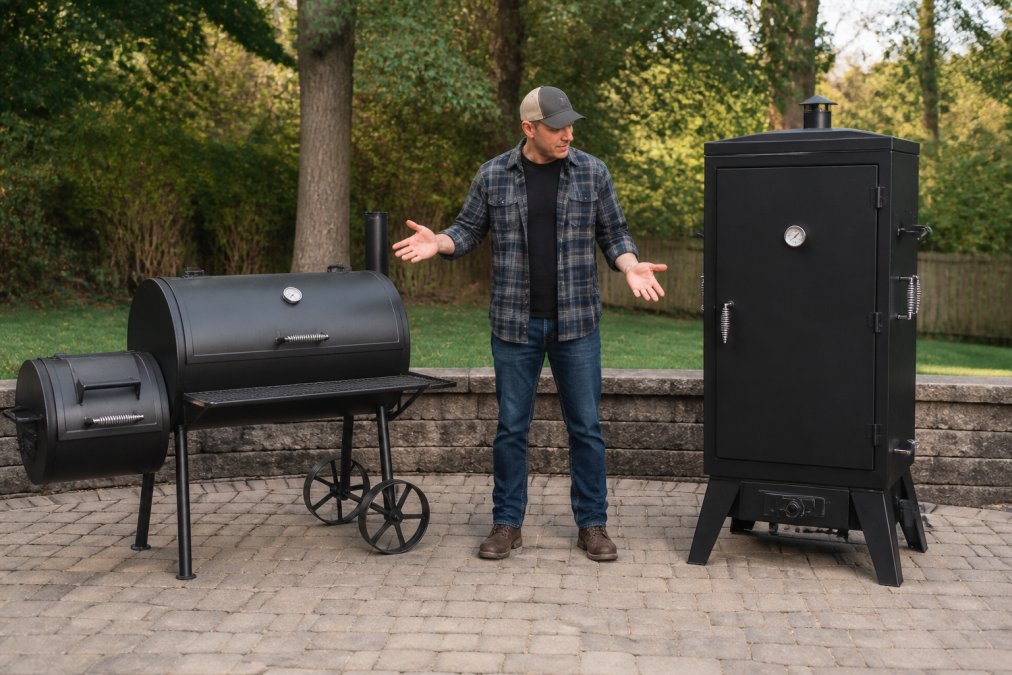
For a homeowner with a compact space, a vertical smoker is often the better fit. For someone with a large open yard and a desire for traditional offset cooking, the horizontal layout wins. Measure your available space before you shop, and allow room to stand, open the door or lid, and add fuel safely.
Match Capacity to Your Backyard and Cooking Volume
Cooking capacity is measured in square inches of cooking surface area, but that number only tells part of the story. You also need to consider how the racks are arranged and whether the smoker can hold the cuts you plan to cook.
A whole brisket or a large turkey needs enough horizontal space to lie flat without touching the sides of the chamber. Taller vertical smokers with multiple racks can hold a lot of food, but the racks may not be far enough apart for a large bird or a thick brisket.
As a general rule, a smoker with roughly 500 to 800 square inches of cooking surface works well for most home cooks who host occasional gatherings. If you regularly cook for large parties or want to smoke multiple briskets at once, look toward the larger end of the range or consider a model with adjustable racks. Exact capacity varies by model, so confirm the cooking surface area on the specific product page before you buy.
Also think about what happens after the cook. A smoker that is too large takes longer to reach temperature and uses more fuel for small cooks. Matching capacity to your typical batch size is more efficient than buying the biggest unit available.
Build Quality and Temperature Control: What to Inspect
Temperature control is the heart of good barbecue, and build quality determines how well a smoker holds steady heat over a long cook. But "build quality" is not a single feature. It combines material thickness, construction methods, and design choices that directly affect how the smoker performs in your specific environment.
Look for heavy-duty construction with thick metal. Thicker steel retains heat better and resists warping from high temperatures. Metal gauge matters, though the ideal thickness varies by fuel type and design—confirm the gauge on the manufacturer's spec sheet rather than assuming, since it differs between a vertical propane smoker and a heavier offset smoker. Regardless of the exact gauge, thicker steel acts as a heat battery, smoothing out temperature swings when you open the door or add fuel.
Insulation is another factor. Double-walled bodies and doors help maintain consistent internal temperatures, especially in cooler weather. A smoker with a single-wall body loses heat faster on a cold, windy day, forcing the heating element or burner to work harder and cycle more often. This leads to wider temperature swings and longer cook times. If you live in a climate with cold winters or big temperature swings between day and night, insulation isn't a luxury; it is a necessity for predictable results.
Inspect the cooking grates. Cast iron or stainless steel grates hold heat well and are easier to clean than thin chrome wire. Check the seals around doors and lids. Gaps let heat and smoke escape, making temperature regulation harder. A simple test is to close the door on a piece of paper; if it slides out easily, the seal is not tight. Thin metal and poor door seals are the most common causes of frustrating smoker performance. A smoker that leaks heat will struggle to hold a steady temperature, leading to inconsistent results and longer cook times.
A built-in thermometer is convenient, but many are inaccurate. Most experienced cooks rely on a separate probe thermometer placed at grate level to track the actual cooking temperature and the meat's internal temperature. The placement of the built-in thermometer matters too; one mounted in the lid reads the temperature at the top of the chamber, which can be significantly different from the temperature at the grate where the meat sits.
Climate-specific performance is a factor most buyer's guides ignore. In a humid environment, a smoker with poor insulation will struggle to hold temperature because the moisture in the air conducts heat away from the metal shell more efficiently than dry air. In a dry, windy climate, the wind strips heat from the exterior, causing the internal temperature to fluctuate. A smoker with a thicker body and tight seals will be more forgiving in both scenarios. If you plan to smoke in winter, look for models with higher BTU output or a larger firebox to compensate for increased heat loss. If you live in a hot, sunny climate, consider where you will place the smoker; direct sun on a dark-colored unit can cause the internal temperature to run higher than the controller setting, especially on electric models.
The Best Smoker for Beginners: Where to Start
For someone new to smoking, the best smoker removes the biggest variable: temperature control.
Electric smokers are the most forgiving place to start. They maintain a steady temperature automatically, which lets a beginner focus on wood choice, meat preparation, and cook times without constantly adjusting dampers. The smoke flavor is lighter, but it is a reliable way to learn the fundamentals of low-and-slow cooking.
Propane smokers offer a similar hands-off experience in a cabinet-style vertical layout. They are a strong option if you already have a propane tank on hand for a grill and want the convenience of gas.
A pellet grill is another beginner-friendly route, though the initial investment is often higher. The automated temperature control produces consistent results across many foods.
The learning curve is steepest with charcoal and offset smokers. These require you to manage airflow, fuel, and temperature manually. Many beginners start with an electric or propane model and graduate to charcoal once they understand the principles of smoke management. When you are learning, keep notes on every cook — what you smoked, what wood you used, the temperature you held, and how long it took. Those notes become your personal playbook and speed up the learning curve considerably.
Your Outdoor Smoker Comparison Checklist
Use this checklist when comparing specific models side by side.
- Fuel type: Does the fuel fit your cooking style and convenience needs?
- Layout: Does the footprint fit your available outdoor space?
- Cooking surface area: Can it hold the cuts you plan to cook?
- Rack spacing: Is there enough vertical room for large items?
- Build quality: Is the metal thick and the construction sturdy?
- Door and lid seals: Do they close tightly without gaps?
- Temperature control: How do you regulate heat, and how steady is it?
- Ash management: How easy is cleanup between cooks?
- Ventilation: Are the dampers or stack adjustable and easy to reach?
- Climate fit: Will the smoker hold temperature well in your local weather?
Conclusion: Choose the Model That Matches Your Goals
The best outdoor smoker for your backyard fits how you cook, the space you have, and the time you are willing to invest. Start with your cooking style, narrow down the fuel type, measure your space, and inspect build quality before you commit. Backyard Kitchens Direct carries a selection of smokers, including vertical propane and electric models and a charcoal grill with an offset smoker attachment so that you can compare practical features side by side. Explore Backyard Cooking Options to see what fits your patio and your approach to low-and-slow cooking.
Frequently Asked Questions
What type of smoker is best for a beginner?
For most beginners, a vertical smoker with digital controls or a propane gas smoker offers the most forgiving learning curve. These models maintain steady temperatures with less hands-on attention, letting you focus on technique rather than fire management. The Broil King Smoke Vertical Propane Gas Smoker is one example of a cabinet-style unit that simplifies the process. A charcoal or offset smoker requires more practice to master airflow and fuel control, so it works better for someone ready to invest time in learning traditional methods.
Which is better, a vertical smoker or an offset smoker?
The choice between an offset vs. vertical smoker comes down to how much hands-on time you want and how much space you have. Offset smokers produce a pronounced wood-smoke flavor and suit pitmasters who enjoy tending a fire, but they need more room and constant attention. Vertical smokers are more compact, hold steady temperatures more easily, and work well for batch cooking with multiple racks. Your decision should factor in your patio footprint and whether you want a more involved cooking process or a set-it-and-monitor-it experience.
How does fuel type impact the outdoor smoking process?
Fuel choice shapes the flavor profile and the level of effort required. Charcoal smokers, often paired with wood chunks, deliver a classic smoky taste but demand careful airflow management. Propane gas smokers offer consistent heat with simple dial control, making them a practical option for weekday cooks. Electric smokers provide the most hands-off experience, with digital temperature settings that hold steady for hours. Consider how much time you want to spend managing the fire versus how much smoky flavor you want in the finished meat.
What capacity should I look for in a backyard smoker?
Capacity should match how you typically cook. A smoker with roughly 500 to 800 square inches of cooking surface handles several racks of ribs or a couple of pork butts for family gatherings. If you frequently cook for larger groups or want to smoke multiple items at once, look for vertical models with four or more adjustable racks, like the Broil King Smoke Vertical Propane Gas Smoker, which has four adjustable stainless steel racks. Also confirm the smoker fits your available footprint, including clearance for the lid or firebox door to open fully.