Freestanding vs Built-In Griddle: 7 Things to Compare
Last Updated: November 21, 2026
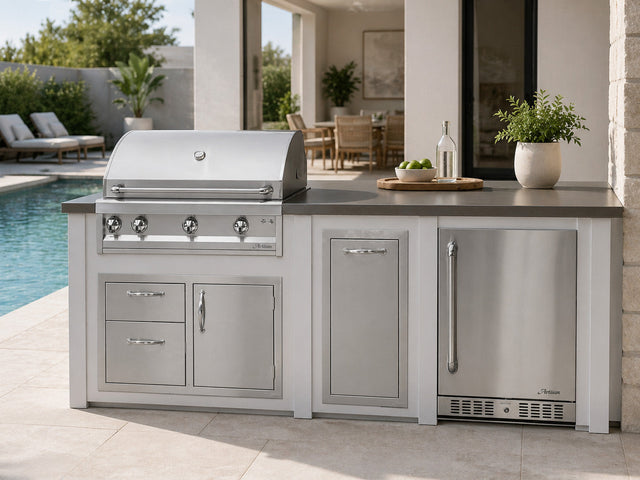
A freestanding griddle sits on its own cart and can roll wherever you need it. A built-in griddle is a griddle head installed in a cutout in an outdoor kitchen island, so it stays put and the island supplies the storage and counter space around it. The cooking surface can be nearly the same either way. What changes is the footprint, the prep space, the installation work and how you protect and eventually replace the unit. This guide compares seven things that separate the two setups, plus a third option: a built-in griddle head on a matching cart.
Table of Contents
- 1. Cart or Island: The Core Difference
- 2. Footprint and Mobility
- 3. Prep and Landing Space
- 4. The Built-In Griddle Cutout and Installation
- 5. Fuel and Power
- 6. Cooking Surface and Burners
- 7. Weather, Cleaning and Replacement
- A Third Option: A Built-In Griddle Head on a Cart
- Freestanding vs Built-In Griddle at a Glance
- Which Griddle Fits Your Patio
- Frequently Asked Questions
1. Cart or Island: The Core Difference
The core difference between a freestanding outdoor griddle and a built-in griddle is where the cooking unit lives. A freestanding griddle comes on its own cart, with its own storage and wheels. A built-in griddle is a head-only unit made to be installed in an outdoor kitchen island, and the island provides everything around it.
The Summerset Griddle Pro 30 shows this clearly because it is sold both ways. The Summerset Griddle Pro 30-Inch Freestanding Gas Griddle sets the griddle on Summerset's stainless steel Griddle Pro Cart. The Summerset Griddle Pro 30-Inch Built-In Gas Griddle is the same style of griddle as a head for a custom island. Same cooking surface, very different setup.
If you are still deciding whether you want a griddle at all, or which size and fuel, start with our guide on how to choose an outdoor griddle.
2. Footprint and Mobility
A freestanding griddle is the flexible choice. The Summerset Griddle Pro Cart has locking casters, so the griddle can roll into position for a cookout and back to a storage spot afterward. Its shelves collapse, which helps when you put it away.
The trade-off is that a cart takes up open patio space whenever it is out, and you need room for the shelves when they are up. Cart assembly is required on the Summerset freestanding model, so plan a little setup time when it arrives.
A built-in griddle has no footprint of its own. It becomes part of the island, which means it never moves, but it also never sits in the middle of the patio. If the island is already part of your plan, a built-in griddle adds flat-top cooking without adding another piece of equipment to work around.

3. Prep and Landing Space
Griddle cooking moves fast, so the space beside the cooking surface matters as much as the surface itself. You need somewhere to set plates, tools, oil and the next batch of food.
On a cart, that space comes from the cart's side shelves plus whatever table or counter sits nearby. It works well for one cook and a typical family meal.
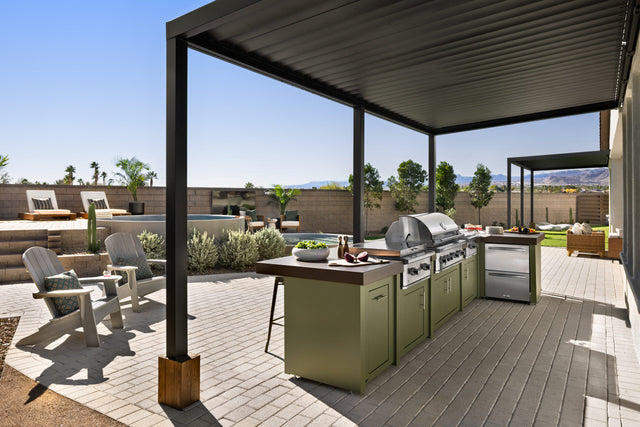
In an island, the counter on each side of the griddle becomes your landing space, and doors or drawers below can hold tools and supplies. That suits entertaining and longer cooks, but it only works if the island is planned with enough counter on both sides. Our guide to outdoor kitchen island space requirements covers counter runs, walkways and door swings.
4. The Built-In Griddle Cutout and Installation
The cutout is the part of a built-in griddle decision that is hardest to change later. The griddle head drops into an opening in the island, and that opening has to match the exact model you buy.
The built-in griddles we carry are designed for outdoor installation in a suitable non-combustible enclosure, according to their listings. Each one has its own installation manual with the cutout size, ventilation and clearance requirements. Cutouts are model-specific, so don't assume one 30-inch griddle head will fit another's opening.
A practical order of operations:
- Choose the griddle head first. Then build the island plan around its manual, not the other way around.
- Confirm the cutout, ventilation and clearances in the manual for that exact model.
- Plan the gas supply and any electrical needs before the island is built (see the next section).
- Have a qualified installer review the plan before construction, and follow local codes.
A freestanding griddle skips the cutout entirely. You still follow the manual for clearances from walls and anything that can burn, but there is no enclosure to build.

5. Fuel and Power
Every griddle in this comparison comes in propane and natural gas versions, so pick the version that matches your supply before you order.
- Propane can come from a portable cylinder or, where the product and setup allow, a larger property-level tank. The Summerset freestanding cart has propane tank storage built in. In an island, plan where the tank sits and how you reach it.
- Natural gas runs from your home's supply where one is available, and it needs a gas line run to the griddle's location. Don't assume natural gas is available at your address until you confirm it.
Power is easy to overlook. Both Summerset Griddle Pro versions have griddle lighting that needs an electrical connection, according to their listings. Check the manual for any model you are considering and plan an outlet or circuit before the island is finished.
Have a qualified, licensed professional make gas and electrical connections, and follow the manufacturer's manual and local codes.
6. Cooking Surface and Burners
Cooking performance depends on the model, not the format. The Summerset Griddle Pro 30 has the same cooking specs in both versions: a 495 sq. in., 8 mm-thick #304 stainless steel cooking surface over two 18,000-BTU U-tube burners, with a heat-zone separator for cooking at two temperatures. Summerset lists breakfasts, smash burgers, fajitas and hibachi-style cooking as good fits.
Other built-in options take different approaches:
- The Wildfire Ranch Pro 30-inch Built-In Gas Griddle is made from 304 stainless steel in stainless or black stainless finishes, and it is designed to coordinate with Wildfire's Ranch Pro grills, burners and storage for a matching island. See the full Wildfire Outdoor Living lineup.
- The Bull 30-Inch Built-In Gas Griddle has a 304 stainless steel body, a chromium-plated cooking surface and four welded stainless steel burners, with piezo ignition and a thermometer.
Compare every model in the built-in gas griddles collection or the freestanding gas griddles collection, and check each product page for its current specifications.
7. Weather, Cleaning and Replacement
A freestanding griddle can roll under a roof or into a garage when it is not in use. A built-in griddle stays where it is installed, so its protection comes from a cover and from any roof or pergola over the island. Wildfire, for example, makes covers sized for each Ranch Pro griddle and cart.
Cleaning is similar on both. Scrape the surface after cooking, empty the grease tray as the manual directs, and keep the area around the griddle clear so you can reach the tray easily. On a built-in, leave enough room in front of the island to work.
Replacement is where the two differ most. A freestanding griddle can be rolled away and swapped for another. A built-in replacement has to fit the existing cutout, so a different model may mean changing the opening. Keep the manual for any built-in you install.
A Third Option: A Built-In Griddle Head on a Cart
Some built-in griddle heads have a matching cart. The Wildfire Ranch Pro Griddle Cart holds the Ranch Pro gas griddle head and turns it into a rolling flat-top station. It is 304 stainless steel in two finishes, with two drawers and a double-lined door, a slide-out drawer for the propane tank, fold-down removable side shelves and heavy-duty locking casters. The griddle head is sold separately.
This gives you the look of the Ranch Pro line with the flexibility of a cart, without building an island first. Confirm the head and cart pairing on the product pages before ordering.
Freestanding vs Built-In Griddle at a Glance
| Factor | Freestanding Griddle | Built-In Griddle |
|---|---|---|
| Placement | On its own cart; rolls into place | Fixed in an island cutout |
| Footprint | Open patio space when out | Part of the island |
| Prep space | Cart shelves plus a nearby table | Island counter on each side |
| Installation | Cart assembly; gas connection per the manual | Model-specific cutout, enclosure, gas and any electrical |
| Propane storage | On the cart | Planned into the island |
| Replacement | Roll out and swap | Must fit the existing cutout |
| Best for | Patios and decks without an island | Permanent outdoor kitchens |
Which Griddle Fits Your Patio
Match the format to your space and plans, not to a spec sheet.
- No island, or a small patio: a freestanding griddle on a cart.
- You may move or rearrange the patio: a freestanding griddle, or a built-in head on a matching cart.
- A permanent outdoor kitchen is planned: a built-in griddle, chosen before the island is designed.
- You want a matching Ranch Pro look now and an island later: the Wildfire Ranch Pro griddle head on its cart. Check the manuals before you plan a later move into an island.
Neither format is better in every case. The right one is the one that fits how your patio works.
Backyard Kitchens Direct is veteran-owned. Questions before ordering? Call (904) 621-2505.
Frequently Asked Questions
What is the difference between a freestanding griddle and a built-in griddle?
A freestanding griddle comes on its own cart, so it rolls into place and needs no island. A built-in griddle is a griddle head installed in a cutout in an outdoor kitchen island, so the island provides the structure, storage and counter space around it. The cooking surface can be the same: the Summerset Griddle Pro 30 is sold both ways with the same cooking specs.
Can a built-in griddle be used on a cart?
Only when the manufacturer makes a matching cart for that griddle head. The Wildfire Ranch Pro Griddle Cart is made for the Ranch Pro gas griddle head, which is sold separately. Confirm the pairing on the product pages before ordering.
Is a freestanding or built-in griddle better for a small outdoor space?
A freestanding griddle usually fits a small space better, because it needs no island and can roll out of the way when you are not cooking. A built-in griddle needs an island with enough counter on each side to be useful.
Will any 30-inch built-in griddle fit my island cutout?
Not necessarily. Cutout sizes are model-specific, even between griddles with the same nominal width. Check the installation manual for the exact model and confirm it with a qualified installer before the island is built or a replacement is ordered.
How much space should I plan around an outdoor griddle?
Plan for the griddle itself, landing space on both sides for plates and tools, and room to open the lid and move past safely. Follow the manufacturer's manual for clearances from walls and anything that can burn, and have a licensed professional handle gas and electrical work.