Durable Outdoor Kitchen Island Materials: What Lasts
Last Updated: November 6, 2026
The most durable outdoor kitchen island is the one whose frame, cabinets, and countertop suit the sun, rain, salt air, and freeze-thaw cycles they will actually face. This guide compares the common frame and countertop materials, explains how the parts work together, and shows what to verify on a product page before you buy.
Table of Contents
- Why Outdoor Kitchen Island Materials Fail
- The Best Material for an Outdoor Kitchen Frame
- Outdoor Kitchen Cabinets: Storage That Survives the Season
- The Best Material for Outdoor Kitchen Countertops
- What a Modular Outdoor Kitchen Changes About Material Choice
- Weather, Sun, and Coastal Exposure: What to Ask Before You Buy
- Comparing Materials Side by Side: Pros, Cons, and Upkeep
- Browse Outdoor Kitchen Islands Built From Materials You Can Verify
- Frequently Asked Questions
Why Outdoor Kitchen Island Materials Fail
Many island problems trace back to one mistake: choosing a material for how it looks on day one rather than how it behaves after years outdoors.
A common failure pattern is mixing materials that expand, absorb water, or dry out at different rates. A frame that holds up fine on its own can still push a countertop out of level, or open a joint, when the two move differently through the seasons.
The Best Material for an Outdoor Kitchen Frame
The best material for an outdoor kitchen frame depends on exposure and budget, but three families cover most builds: metal, masonry, and polymer. Each handles moisture differently, and that difference drives most of the other decisions. The frame also sets how the countertop, cladding, and cabinets move together through the seasons.
Metal Frames: Stainless Steel and Powder-Coated Steel
Stainless steel is a common choice for wet, salty, or humid settings. AISI 304 is a common baseline grade, and AISI 316 is often specified where coastal salt exposure is a concern. Powder-coated steel typically costs less and offers color options, but any chip in the coating exposes steel that can rust.
A metal frame changes size very little with moisture, so a countertop supported on it tends to stay level across wet and dry seasons.
Masonry and Concrete Frames
Masonry and concrete deliver mass, stability, and a built-in look. The trade-offs are weight and moisture: concrete and cement board can wick water, and a stone veneer can hold it against the structure if drainage and sealing are handled poorly.
The compatibility issue with masonry is differential movement. A concrete or block frame moves very little, while the veneer on its face and the countertop on top can expand and contract at different rates.
Polymer and Marine-Grade HDPE Frames
Marine-grade HDPE (high-density polyethylene) and other polymer frames resist moisture, rot, and insects, which is why they show up in coastal and humid climates. HDPE does not absorb water the way wood does.
HDPE does expand and contract more than metal or stone as temperatures swing, so how the countertop is supported and fastened matters. In a manufacturer-built package, the base and countertop are designed to go together; follow that manufacturer's installation instructions rather than improvising the attachment.
How the Frame, Cladding, Countertop, and Cabinets Work Together
A durable island is one assembly, not four independent purchases. The frame carries the load and sets the movement rate. The cladding sheds water and, if it is stone veneer, adds mass and a second moisture path. The countertop spans the frame and has to tolerate the same heat and movement. Cabinets and drawers mount in the frame and depend on it staying square.
Three details decide how well those parts cooperate:
- Fasteners. Use the fasteners the manufacturer or builder specifies for the frame material, and avoid bare steel anywhere it can sit in moisture.
- Drainage and ventilation. Water that gets behind cladding or into a cabinet run needs a way out. A fully sealed island with no ventilation can trap moisture and heat.
- Movement joints. Countertops, veneer, and cabinet faces need a small allowance for expansion. A rigid joint between two materials that move at different rates is a common place for cracks to start.
Even a heavily built frame can develop problems if the countertop is locked rigidly to it and the cladding has no way to drain.
Outdoor Kitchen Cabinets: Storage That Survives the Season
Outdoor kitchen cabinets decide how useful the island stays season after season. The details matter as much as the material: hinges, drawer slides, gaskets, and how well the unit keeps rain and pests out.
Stainless steel is a common choice for outdoor doors and drawers, and the grade matters as much as the finish. The Wildfire Double Drawer is one example: its listing specifies 304 stainless steel, fully extendable drawers on stainless steel rollers, and soft-close hardware. It is part of the Wildfire Outdoor Living lineup of island components. For a closer look at the trade-offs, see are stainless steel outdoor cabinets worth it.

A sealed cabinet with no ventilation can trap moisture and heat, which is hard on anything stored inside. Ask how the cabinet breathes before assuming stainless means maintenance-free.
The Best Material for Outdoor Kitchen Countertops
The best material for outdoor kitchen countertops balances heat tolerance, porosity, and UV stability. A countertop takes more abuse than most surfaces on the island: direct sun, hot pans, grease, citrus, and, in colder regions, freeze-thaw cycles.
Natural Stone: Granite, Marble, and the Porosity Question
Granite is a common outdoor choice. It generally handles heat well and resists scratching, though most granite is porous enough to need periodic sealing; follow the fabricator's or manufacturer's guidance on how often. Marble is generally a weaker fit outdoors: it is softer, more porous, and can etch from acids and spills. Any natural stone tends to need sealing more often in sunny, freeze-thaw, or coastal conditions.
Porcelain and Sintered Surfaces
Porcelain and sintered stone surfaces are generally described as non-porous and UV-resistant, which makes them worth considering for sun-heavy patios, and they typically resist staining without sealing. The limitation is the edges: thin porcelain edges can chip, so the fabrication and edge profile matter as much as the slab. Confirm the specific product's heat and outdoor-use guidance.
What a Modular Outdoor Kitchen Changes About Material Choice
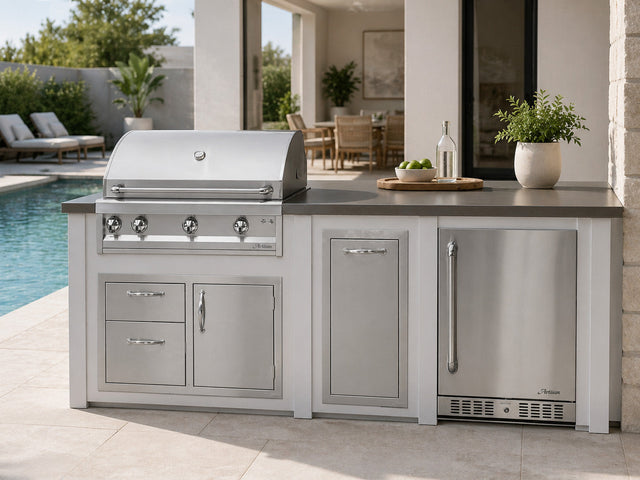
With a modular outdoor kitchen island package, the manufacturer has already chosen the base, countertop, and appliances to work together, so the material decision shifts from what a builder would use to what the package specifies. Site preparation, gas and electrical hookups, and the manufacturer's installation steps still apply.
Two island packages show how this plays out. The 8-Ft DuraKitchen Island Package pairs a marine-grade HDPE base with a Galaxy White granite countertop, and includes the Angus four-burner built-in gas grill, a deluxe stainless steel refrigerator, and a double trash drawer. The ODK Timber Tough Outdoor Kitchen Island Package with Angus Grill uses a Timber Tough base with a leathered granite countertop, and includes the Angus four-burner built-in gas grill, a single side burner, a refrigerator, and a door/drawer combo. Each product page lists its base and countertop materials, which is the source to check before comparing.


Weather, Sun, and Coastal Exposure: What to Ask Before You Buy
Climate is where the real decisions live. Before committing to a modular island, it also helps to know how to prepare your patio for a modular outdoor kitchen: check the surface and level, plan clearances and utilities, and map the delivery route. Three questions separate a material that lasts from one that disappoints.
- How much direct sun does the island get? UV exposure fades finishes and stresses polymers and sealants. Shade and a cover change the maintenance calendar.
- How much rain and standing water? Non-porous surfaces and frames that shed water have the advantage here.
- Is salt air in play? Coastal exposure is where AISI 316 stainless is often specified, and where bare steel fasteners are a liability.
Comparing Materials Side by Side: Pros, Cons, and Upkeep
No single material wins every category. The table below summarizes the general trade-offs so the choice can be matched to climate and how much upkeep you want to take on.
| Material | Strengths | Weaknesses | Upkeep |
|---|---|---|---|
| AISI 304 / 316 stainless steel | Resists moisture and corrosion; clean look | Shows fingerprints and scratches | Wipe down; inspect welds and fasteners |
| Powder-coated steel | Color options; typically lower cost | Chips can expose steel to rust | Touch up the coating |
| Masonry and concrete | Stable; built-in appearance | Heavy; can wick moisture | Seal; check drainage |
| Marine-grade HDPE / polymer | Rot and insect resistant | Expands and contracts with temperature | Clean; check fasteners |
| Granite | Generally heat and scratch resistant | Porous; typically needs sealing | Re-seal per guidance |
| Marble | Distinctive look | Soft; can etch and stain | Frequent sealing |
| Porcelain / sintered stone | Generally non-porous and UV-resistant | Edges can chip | Minimal sealing |
Match the Material to the Climate, Not the Photo
The same island that performs on a covered patio in a dry climate can disappoint on an exposed deck in a wet one. Three exposure patterns drive most of the difference:
- Freeze-thaw cycles. Porous stone and trapped moisture are the risk. Water that soaks into stone or a cement substrate and then freezes can damage the surface and open joints.
- Coastal salt air. Salt film holds moisture against metal. Rinse and clean surfaces as the manufacturer's care instructions recommend.
- Intense sun. UV fades finishes, stresses polymers, and shortens the life of sealants. A covered island or a fitted cover changes the maintenance calendar.
Heat Exposure Around Grills and Burners
A built-in grill or side burner radiates heat into the countertop, the cabinet face, and the frame around it. Some appliances are installed with an insulated liner for that reason. The Wildfire Insulated Jacket is an insulated liner that sits between a Wildfire built-in appliance and the island, sized to fit each Ranch Pro grill, griddle, and burner.

A countertop that handles a hot pan is not automatically suited to the sustained heat of a built-in grill head. The appliance's installation manual sets the clearances and states when an insulated jacket is required.
Lifecycle Upkeep, Not Just Day-One Durability
Two surfaces can ask very different amounts of work over the life of an island. A porous stone that needs re-sealing, a powder-coated frame that needs touch-ups after chips, and a polymer frame whose fasteners should be checked as it moves all carry recurring work. The comparison is not just which material lasts, but which one asks less of you each season.
A Short Selection Matrix by Build Type
- Modular island package. The base and countertop are matched by the manufacturer, so the decision is which package fits your climate. Confirm the base material and countertop on the product page rather than assuming.
- Built-in grill on a cart. A built-in grill head on a matching cart is a mobile setup, not an island. Material choice is limited to the cart and any side shelves.
- Contractor-built island. The frame, cladding, countertop, and cabinets are separate decisions, so the compatibility questions above matter most. Weight, repairability, and how the parts move together should drive the choice.
Browse Outdoor Kitchen Islands Built From Materials You Can Verify
The material list on a product page should match what shows up at the door.
Compare packages in the outdoor kitchen islands collection to see how each one specifies its base and countertop. Planning your own build? The Wildfire island components collection covers built-in doors, drawers, insulated jackets, and refrigeration for a complete island plan.
Questions before ordering? Call (904) 621-2505.
Choosing island materials comes down to matching the frame, cabinets, and countertop to the climate they will actually face, then verifying that the package specifies each one.
Frequently Asked Questions
What is the best material for an outdoor kitchen island frame?
There is no single winner, because the right frame depends on your climate and how the island is built. Stainless steel is a common choice for humid and coastal yards, masonry is stable and solid but heavy and permanent, and marine-grade HDPE resists moisture, rot, and insects without the weight of stone. Ask how the frame handles standing water, salt air, and freeze-thaw cycles, and confirm what the manufacturer says about the material rather than relying on general claims.
Is stainless steel a good material for an outdoor kitchen island?
Stainless steel is a common choice for outdoor kitchen islands because it resists moisture and cleans up easily. The grade matters: AISI 304 is a common baseline, and AISI 316, which contains molybdenum, is often specified for coastal settings. Ask which grade is used on the body, doors, and fasteners, since a mismatched fastener can corrode first. Stainless also shows fingerprints and water spots, so plan on routine wiping.
What should I ask about outdoor kitchen materials in a coastal area?
Salt air speeds up corrosion on metal and holds moisture against surfaces. Ask which stainless grade the frame and hardware use, if the fasteners match, and how the countertop handles salt and humidity. Confirm the sealing schedule the manufacturer recommends for any natural stone, ask how the island sheds water, and check that any built-in appliance has the venting its manufacturer specifies.
How does sun exposure affect outdoor kitchen island materials?
UV light breaks down paints, sealers, and some polymers over time, and dark surfaces absorb more heat. Ask if the finish is described as UV-resistant and how the color holds up in direct sun. Lighter countertops tend to stay cooler to the touch, which matters if you cook in full afternoon sun. For any surface near a grill or griddle, follow the appliance and countertop manufacturers' guidance on heat exposure.