Choosing an Outdoor Kitchen Island: A Buyer's Guide
Last Updated: November 10, 2026
Choosing the right outdoor kitchen island comes down to three things: the space you have, the appliances you want to cook on, and how the island will reach its spot. This guide takes those decisions in order, from layout and length to materials, packaged kits, and site readiness, so you can build a short list before you order.
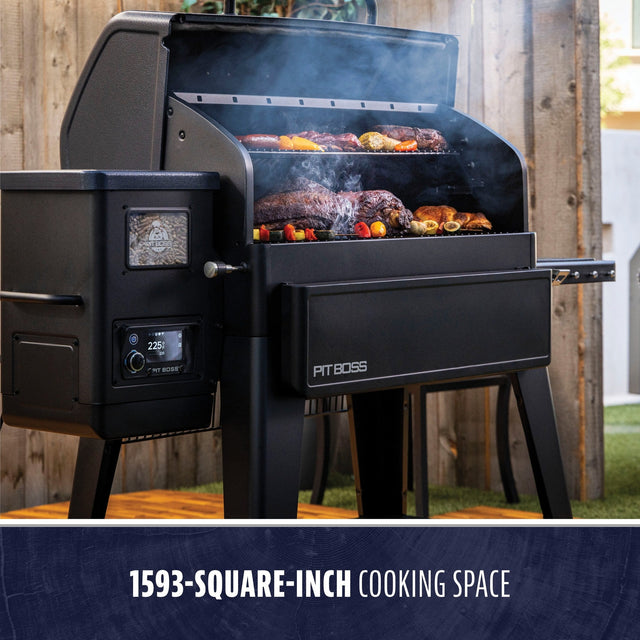
It covers islands that hold built-in appliances. Freestanding grills and griddles sit on their own carts and don't need an island, so if that's your plan, start with the freestanding gas grills collection instead.
Table of Contents
- Start With Your Space and Cooking Goals
- Outdoor Kitchen Island Layout: Straight, L-Shaped, or One-Wall
- Outdoor Kitchen Island Length and Clearances
- Appliance Selection: Grill, Griddle, Burners, Refrigeration, Storage
- Outdoor Kitchen Island Materials and Weather Durability
- Outdoor Kitchen Island Kits vs. Custom Builds Around Wildfire Components
- Utilities, Site Readiness, and Delivery Access
- Plan Your Island Purchase With Backyard Kitchens Direct
- Frequently Asked Questions
Start With Your Space and Cooking Goals
Start with your patio footprint, the length of wall or open space you can give to cooking, and how you actually cook.
Measure the footprint with a tape measure, noting patio edges, steps, and nearby door swings. Then list what you want to do out there: gas grilling, griddle breakfasts, side-burner pots, cold drinks within reach, tools stored out of the weather.
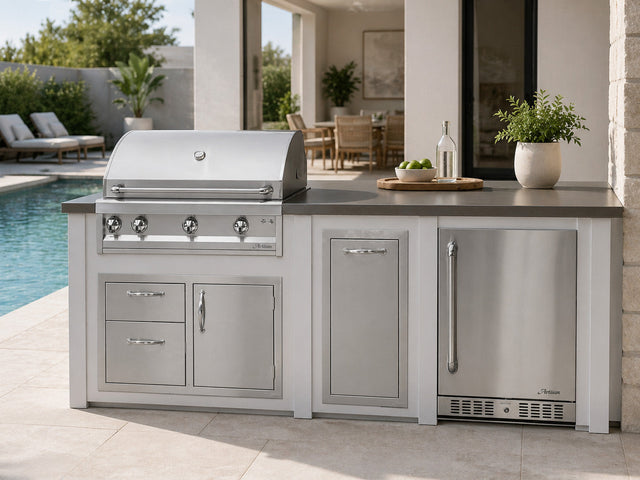
An outdoor kitchen island is a counter unit that holds built-in cooking appliances, storage, and often refrigeration in one footprint.
Answer three questions before you shop:
- Who are you cooking for? A weeknight dinner for four and a regular crowd on weekends call for different amounts of grill and counter space.
- Which appliances do you want built in? A grill, a griddle, a side or power burner, refrigeration, and storage each add width.
- Where will the island stand? Against a wall or fence, or out in the open where people can gather around it.
Outdoor Kitchen Island Layout: Straight, L-Shaped, or One-Wall
Layout decides how the island feels in use. Three layouts cover most patios:
- Straight: one run of counter, open on both long sides. It keeps traffic moving in one direction and suits narrow patios.
- L-shaped: two runs that meet at a corner. It uses corner space and keeps the cook central, with cooking on one leg and prep or serving on the other. It needs floor space in two directions.
- One-wall: a straight run set against the house, a fence, or a garden wall. It saves open patio space, and guests gather on the open side. Before placing a grill near any wall, check the clearances in the grill's installation manual.
Match the layout to the yard, not to a photo. A long, narrow patio handles a straight island better than an L-shape that crowds the walkway.
Think about workflow, too. The cook needs room to move between the grill, prep area, and storage without stepping around guests.
Outdoor Kitchen Island Length and Clearances
Island length should follow the appliances you plan to hold, plus counter space for prep. Add up the widths of the grill, any side burner, refrigeration, and storage, then leave working room between them.
Clearance matters as much as length. Leave walking room behind the cook, and keep the island far enough from walls, railings, and patio edges that doors and drawers open fully.
Plan these zones on paper:
- Cooking zone: the grill, griddle, and any side or power burner.
- Prep zone: open counter beside the grill for trays, plates, and tools.
- Cold zone: refrigeration and drinks, placed where each appliance's installation instructions allow.
- Storage zone: doors and drawers for tools, covers, and cleaning supplies.
A Measurement Worksheet You Can Fill In
A simple worksheet catches fit problems before an order is placed. Copy these lines into a notebook and fill them in with a tape measure:
- Total available run: the length of wall, fence, or open patio edge you can dedicate to the island.
- Appliance widths: the cutout width listed for each built-in grill, griddle, side burner, refrigerator, and storage unit. Use the manufacturer's published cutout dimensions, not the outer width.
- Prep allowance: the counter length you want between the grill and the next appliance.
- End margins: the counter overhang or filler you want at each end of the run.
- Door and drawer swing: the depth each door or drawer projects when fully open.
- Walkway behind the cook: the clear path between the island and the nearest wall, railing, step, or patio edge.
- Approach at each end: the clear space so people can step in and out of the cooking zone.
Add lines 2, 3, and 4 for a working island length, then check it against line 1. If the working length is longer than the available run, cut an appliance or shorten the prep allowance before you shop.
A Sample Layout, Worked Through
Suppose a homeowner wants a straight island with a built-in gas grill, a single side burner, an outdoor refrigerator, and a door and drawer combo. On paper:
- Grill, side burner, refrigerator, and storage cutouts, each from the manufacturer's published dimensions
- A prep run between the grill and the side burner
- A short landing between the refrigerator and storage so doors do not collide
- End margins at both ends
Lay the cutouts out in a line on graph paper, one square to the inch, and mark the swing arc of every door and drawer. Then draw the walkway behind the cook and the approach at each end. If any arc crosses the walkway or approach, the island is too deep or the appliances need rearranging.
Clearances That Affect the Footprint
Clearance is not one number. It is the space the cook stands in, the space a door or drawer needs to open, and the space guests need to pass. Measure each one separately and add them to the island depth, not just its length.
Built-in grills, burners, and refrigerators also list their own clearance and ventilation requirements in their installation manuals. Read them before you settle the layout.
Appliance Selection: Grill, Griddle, Burners, Refrigeration, Storage
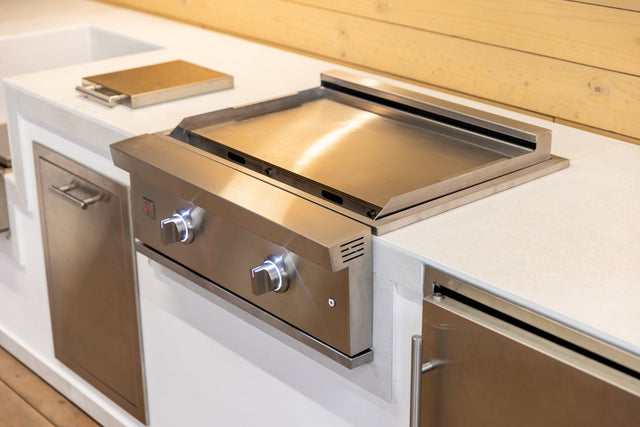
Appliance choice drives island length more than any other decision. A built-in gas grill anchors most islands. A built-in griddle adds flat-top cooking space, a side or power burner handles pots and pans, and refrigeration and storage keep supplies within reach.
Decide built-in versus freestanding early. Built-in appliances drop into a cutout and need the island sized around them. Freestanding grills and griddles sit on their own cart and stand apart from the island.
For a custom island, Wildfire's Ranch Pro line is made to work together. The Wildfire Ranch Pro Built-In Gas Grill comes in 30-, 36-, and 42-inch sizes, in stainless or black stainless steel, for natural gas or propane, and it's designed to coordinate with Ranch Pro griddles, burners, and storage. The built-in gas griddles collection includes the Ranch Pro 30-inch built-in griddle. Browse the full lineup on the Wildfire Outdoor Living page, or see how the pieces fit in our guide to planning an outdoor kitchen island with Wildfire components.

Outdoor Kitchen Island Materials and Weather Durability
Materials decide how the island holds up to sun, rain, and freeze-thaw cycles. Each one comes with a trade-off in weight, look, and care. Our guide to durable outdoor kitchen island materials covers them in more depth.
How Each Material Handles the Weather
The table below compares common island materials against moisture, sun, freezing, and coastal air. It describes general material behavior, not any specific product's rating, so check each product page for its exact construction and the manufacturer's care guidance.
| Material | Rain and Moisture | Sun and Freezing | Coastal Air | Care Pattern |
|---|---|---|---|---|
| Stainless steel | Sheds water; joints and fasteners are the places to watch | Finish can dull without cleaning; keep water from pooling in joints | Grades differ, so check the grade on the product page | Regular cleaning of surfaces and joints |
| Marine-grade HDPE | A plastic that doesn't soak up water or rot | Color can fade with long sun exposure | Doesn't rust | Soap-and-water cleaning |
| Granite countertops | Seams and any sealer are the places to watch | Follow the manufacturer's sealing and care guidance for your climate | Stone doesn't rust; check metal fasteners and brackets | Cleaning, plus resealing if the finish calls for it |
Use the table as a starting point, then match the material to your climate. A coastal yard puts a premium on corrosion resistance. A cold-winter yard puts a premium on materials that don't hold water that can freeze. A hot, sunny yard puts a premium on finishes that hold their color.
Base and Top Are Separate Decisions
The base and the countertop are separate choices. Pick each one for the layout, the look you want, and the weight your patio surface can carry. A packaged island settles both for you; a custom build leaves both open.
Maintenance by Season
A simple seasonal routine keeps any material in better shape:
- Before the season: inspect joints, fasteners, and door hardware; clean surfaces; check covers for tears.
- During heavy use: wipe down the top after cooks; keep grill and refrigerator vents clear.
- Before winter or the rainy season: confirm covers fit and shed water; check that water doesn't pool at the base.
- After storms: dry joints and hardware; look for standing water or finish damage.
Outdoor Kitchen Island Kits vs. Custom Builds Around Wildfire Components
Kits and custom builds solve different problems. An outdoor kitchen island kit is a matched package: the base, countertop, and appliances are already chosen to fit together. A custom island is built around components you pick. Our guide on modular outdoor kitchen islands vs. a custom build compares the two approaches.
Backyard Kitchens Direct carries two island packages in its outdoor kitchen islands collection. The Bull ODK Timber Tough Outdoor Kitchen Island Package with Angus Grill pairs a Timber Tough base with a leathered granite countertop. It includes the Angus four-burner built-in gas grill, a single side burner, a Contemporary refrigerator, and a door/drawer combo, and it comes in two color sets and in propane or natural gas configurations.

The Bull Myrtle Beach 8-Ft DuraKitchen Island Package uses a marine-grade HDPE base in Symphony Blue with a Galaxy White granite countertop. It includes the Angus four-burner built-in gas grill, a deluxe stainless steel refrigerator, and a double trash drawer, with CSA-certified grill cabinet venting, in propane or natural gas configurations.

| Option | Base and Top | Included Appliances | Good Fit For |
|---|---|---|---|
| Bull ODK Timber Tough package | Timber Tough base, leathered granite top | Angus built-in gas grill, single side burner, Contemporary refrigerator, door/drawer combo | Buyers who want a side burner and a choice of two color sets |
| Bull Myrtle Beach 8-Ft DuraKitchen package | Marine-grade HDPE base, Galaxy White granite top | Angus built-in gas grill, deluxe refrigerator, double trash drawer | Buyers who want trash storage built in and an HDPE base |
| Custom island around Wildfire components | Your choice of base and top, built by your builder | Your mix of Wildfire built-in grill, griddle, burners, refrigeration, and storage | Buyers who want control over layout and appliance mix |
A custom build around Wildfire components suits buyers who want a specific grill, griddle, or refrigeration setup. The trade-off is more planning: every cutout and clearance has to be worked out before the island is built.
Utilities, Site Readiness, and Delivery Access
A smooth delivery starts with the site. Before you order, confirm the patio surface is solid and level where the island will sit, and plan the route from the curb to that spot. Large items ship curbside by freight, so map gates, steps, and turns along the way, and line up help to move the island into place.
The guide to preparing your patio for a modular outdoor kitchen walks through surface checks, clearances, and delivery routes in more detail.
Utilities belong to licensed professionals. Gas, electrical, and plumbing connections should be handled by a licensed professional who follows local rules and the appliance manual. Backyard Kitchens Direct is a retailer, not an installer or contractor.
Plan Your Island Purchase With Backyard Kitchens Direct
The right island comes from a clear plan: measure the space, pick a layout, size the length to the appliances, choose materials for the climate, and confirm delivery access before ordering. Backyard Kitchens Direct is a veteran-owned online retailer of outdoor kitchen islands, gas grills, griddles, and smokers. Compare the island packages, or browse built-in gas grills to start a custom build. Questions before ordering? Call (904) 621-2505.
Frequently Asked Questions
How do I choose the right size outdoor kitchen island?
Measure your available footprint and leave working clearance on every side you will stand on. Then list the appliances you want: a built-in grill, griddle, side burner, refrigerator, and storage each take up width. Let that list set the island's length rather than picking a size first. A compact straight island suits a small patio; an L-shaped island needs more floor space but gives more counter. Confirm final dimensions against each product page before ordering.
What is the difference between an outdoor kitchen island kit and a custom-built island?
A kit is a packaged island with the base, countertop, and appliances already specified, like the Bull ODK Timber Tough or Myrtle Beach DuraKitchen packages. A custom island is built by you or your builder around components you choose, such as Wildfire built-in grills, griddles, burners, refrigeration, and stainless doors and drawers. Kits simplify the decisions; custom builds give more flexibility on appliance mix and dimensions, with more planning up front.
What materials are used for outdoor kitchen islands?
It varies by island. The Bull ODK Timber Tough package uses a Timber Tough base with a leathered granite countertop. The Bull Myrtle Beach DuraKitchen package uses a marine-grade HDPE base with a Galaxy White granite countertop. Wildfire's Ranch Pro built-in grill, Ranch Pro 30-inch built-in griddle, and door/drawer combo are 304 stainless steel. When comparing, ask how each base and countertop handles sun, rain, and freezing in your climate, and check the product page for the exact construction.
What should I check before an outdoor kitchen island is delivered?
Large items ship curbside by freight, so measure the path from the street to your patio, including gate widths, steps, and turns, and plan who will help move the island into place. Make sure the patio surface is solid and level, and clear the area in advance. Line up a licensed professional for gas, electrical, and any site work, follow the manufacturer's manual for assembly and placement, and review the product page so you know what the package includes.