


Freestanding Gas Grill vs. Built-In Grill: What Fits Your Backyard?
Table of Contents
- Start with the kind of backyard project you want
- How the two formats differ
- Freestanding gas grills
- Built-in grills
- Freestanding vs. built-in: side-by-side
- Mobility, footprint, and future flexibility
- Fuel, installation, and site planning
- Materials, weather exposure, and replacement planning
- Where modular outdoor kitchen islands fit
- Choosing the right format
- Frequently Asked Questions
Last Updated: August 24, 2026
Start with the kind of backyard project you want
Choosing between a freestanding gas grill and a built-in grill is less about which one is "better" and more about the kind of backyard project you want to take on. A freestanding grill keeps the cooking station self-contained. A built-in grill becomes one component of a planned outdoor kitchen.
The practical difference is important: a cart grill can work well when your layout may change, while a built-in grill requires the enclosure, fuel setup, clearances, and cutout dimensions to be planned around the exact model. This guide explains the tradeoffs without treating either format as a one-size-fits-all answer.
How the two formats differ
Freestanding gas grills
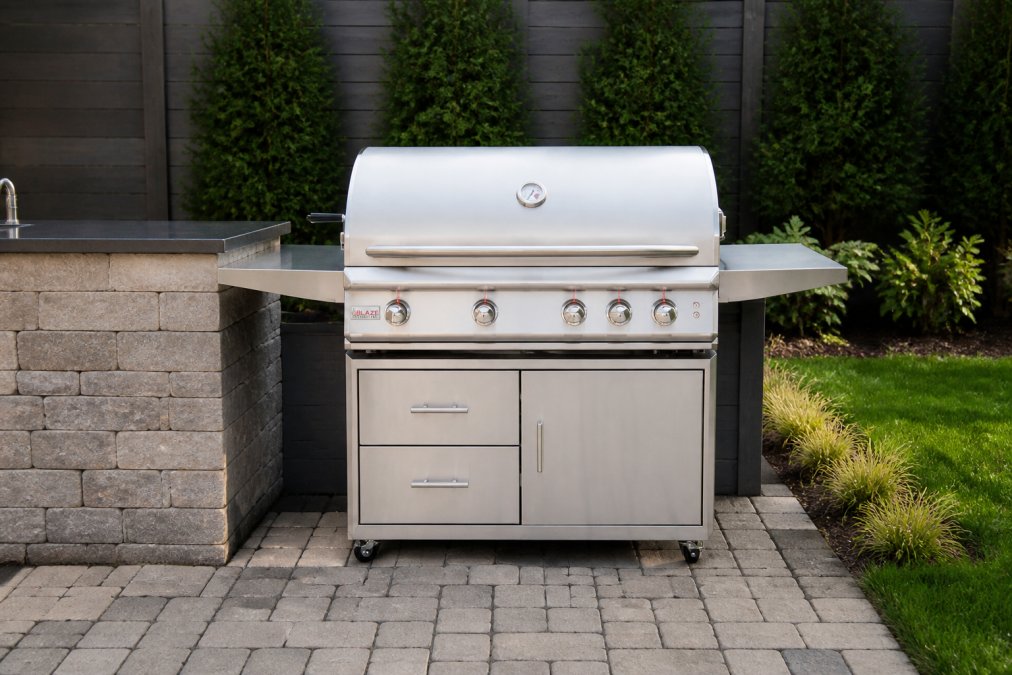
A freestanding gas grill is a complete cooking unit mounted on its own cart. Many cart models include shelves, enclosed storage, and casters, but those features vary by product. The key point is that the grill is designed to operate on its cart rather than inside a custom island.
Freestanding models may be configured for propane or natural gas, depending on the product. Propane models usually use a cylinder stored in or beside the cart. A natural-gas model is connected at a fixed location, so the gas connection still limits the grill's placement. In either case, follow the owner's manual for assembly, fuel connection, clearances, and safe placement. Browse current gas-grill options at Backyard Kitchens Direct.
Built-in grills
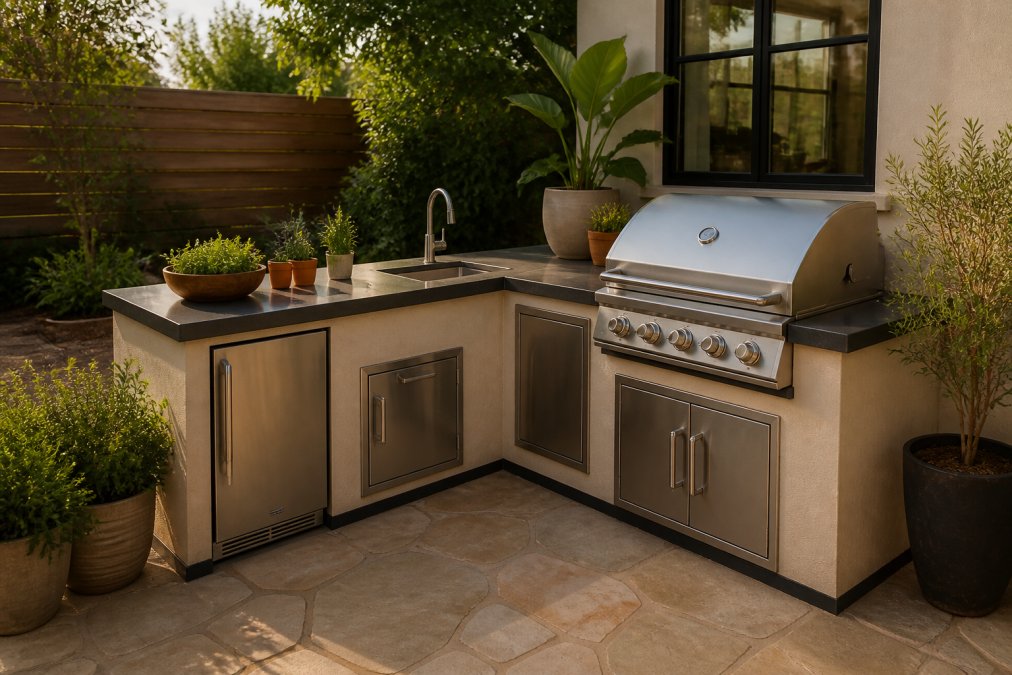
A built-in grill is a grill head designed for installation in a purpose-built island or enclosure. The grill head, countertop opening, enclosure construction, ventilation, and service access must work together. It is not simply a freestanding grill with its cart removed.
Fuel options are model-specific. Built-in grills are available in propane and natural-gas versions, so buyers should confirm the fuel type before selecting a grill head. The manufacturer's installation manual—not a generic rule of thumb—controls the required cutout, clearance to combustible materials, ventilation, and whether an insulated jacket is required.
Freestanding gas grill vs. built-in grill: side-by-side
|
Factor |
Freestanding gas grill |
Built-in grill |
|---|---|---|
|
Format |
Complete grill and cart |
Grill head installed in an enclosure |
|
Placement |
Can be repositioned within the limits of its fuel setup |
Fixed once the island is built |
|
Project scope |
Product selection, assembly, and fuel setup |
Grill selection plus enclosure, cutout, and utility planning |
|
Fuel |
Model-dependent propane or natural gas |
Model-dependent propane or natural gas |
|
Storage and prep space |
Depends on the cart design |
Can be designed into the island |
|
Replacement flexibility |
Usually replace the complete unit |
Future grill choices must work with the existing opening or be modified |
Freestanding grills are usually the simpler purchase because you are choosing one finished product. Built-in grills offer greater design integration, but they create more dependencies: the grill head must be selected early enough so the island can be built around it correctly.
Mobility, footprint, and future flexibility
A freestanding grill is the stronger choice when a patio is still evolving. You can change the furniture layout, move the grill for cleaning, or take it with you when you move—provided the product and fuel connection allow it. Measure the grill's full cart dimensions and leave enough clearance for the lid, doors, shelves, and normal airflow.
A built-in grill is best considered part of the island's overall footprint. Measure more than the grill head: account for countertop depth, landing space, storage, appliance doors, access panels, and the required clearances in the owner's manual. This is where homeowners most often underestimate the space a finished outdoor kitchen will occupy.
Fuel, installation, and site planning
Neither format should be selected on appearance alone. Start with the exact product manual and answer these questions before ordering. For help comparing available product formats, contact Backyard Kitchens Direct.
- Is the model configured for propane, natural gas, or both?
- What are the required clearances and ventilation provisions?
- For a built-in grill, what are the exact cutout dimensions and enclosure requirements?
- Does the model require an insulated jacket when installed near combustible construction?
- Are electrical, water, drainage, or other connections part of the specific product?
- What local approvals or professional work may apply to the planned gas or electrical work?
For a freestanding grill, the goal is a stable, appropriate location with an adequate fuel supply and sufficient clearance. For a built-in project, the goal is to coordinate the enclosure with the grill manufacturer's requirements before construction begins. Do not use a cart grill as a built-in grill unless the manufacturer expressly approves that application.
Materials, weather exposure, and replacement planning
Material quality matters, but no stainless-steel grade eliminates the need for maintenance. Outdoor grills and islands are exposed to grease, moisture, salt air, pollen, and changing temperatures. Use the care instructions for the specific product, clean it regularly, and use a compatible cover when the manufacturer recommends one.
Built-in projects also need a replacement plan. The existing opening may limit future grill choices, especially if the original model is discontinued. Keep the product manual, cutout drawing, and model number with your home records. That small step makes a future discussion about replacement much easier.
Where modular outdoor kitchen islands fit
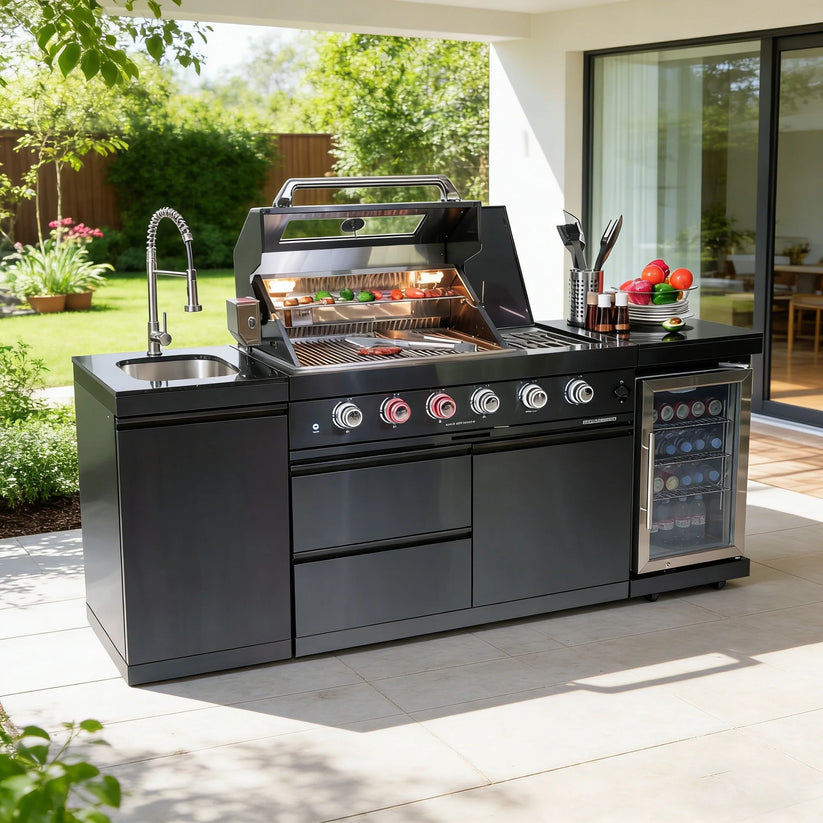
A modular outdoor kitchen island sits between a freestanding grill and a contractor-built outdoor kitchen. It is a factory-built package that may combine an enclosure, countertop, storage, grill, and other appliances. It is not the same as a cart grill, nor is it automatically equivalent to a site-built outdoor kitchen.
Do not assume every modular island has the same assembly, mobility, gas, electrical, water, drainage, or anchoring requirements. Those details vary by SKU. A modular island can reduce custom construction, but buyers should still review the exact product documentation and plan the required connections before delivery.
Which setup fits your backyard?
Choose a freestanding gas grill when you want a self-contained cooking unit, expect your layout to change, or want to avoid custom island construction. It is also a practical starting point for homeowners who want premium cooking capability without committing to a permanent backyard project.
Choose a built-in grill when you have a defined outdoor-kitchen plan and are ready to design the enclosure around the exact grill head. It makes sense when integrated prep space, storage, and a fixed layout are more important than mobility.
Consider a modular outdoor kitchen island when you want an integrated look without commissioning a fully custom island. Treat the individual product documentation as the authority for what still needs to be assembled, connected, or prepared on-site.
The best choice is the one that matches your available space, fuel plan, and willingness to take on a permanent project. Explore backyard cooking options at Backyard Kitchens Direct to compare the formats that fit your plans.
Frequently Asked Questions
What is the main difference between a freestanding gas grill and a built-in grill?
A freestanding gas grill is designed to operate on its own cart. A built-in grill is a grill head designed for installation in a purpose-built island or enclosure. The built-in project must follow the exact manufacturer requirements for the grill head, cutout, ventilation, clearance, and enclosure.
Can a freestanding gas grill be used as a built-in grill?
Not unless the manufacturer expressly approves that installation. Cart grills and built-in grill heads are designed for different applications. Review the owner's manual before considering any enclosure or conversion.
Do built-in grills only use natural gas?
No. Built-in grill fuel options are model-specific. Many built-in grills are available in propane and natural gas versions. Confirm the fuel type, installation requirements, and enclosure details in the manual for the exact grill before ordering.
What is the difference between a modular outdoor kitchen island and a contractor-built outdoor kitchen?
A modular island is a factory-built package that may combine a grill, countertop, storage, and other appliances. A contractor-built kitchen is designed and constructed on site around the chosen components. Requirements for assembly, utilities, mobility, and site preparation vary by product.


