Gas Grill vs. Griddle: Which Setup Fits Your Style?
Table of Contents
- Start With Your Cooking Style
- Compare the Cooking Surfaces
- Match the Equipment to Your Meals
- Compare Workflow, Fuel, and Placement
- Plan for Cleaning and Care
- Use This Decision Checklist
- Frequently Asked Questions
Last Updated: September 5, 2026
Start With Your Cooking Style
A freestanding gas grill and a freestanding gas griddle are different tools, not interchangeable versions of the same appliance. The better choice starts with the meals you make most often, the cooking surface you prefer, and the exact products that fit your patio.
A freestanding gas grill cooks on grates. A freestanding gas griddle uses a continuous flat cooking surface. That difference affects how food is handled, how drippings are managed, and how the equipment is cared for.
Start with your normal cooking routine rather than a generic claim about which one is “better.” Then compare the exact model’s surface, burner controls, overall dimensions, fuel configuration, and owner’s manual.
Compare the Cooking Surfaces
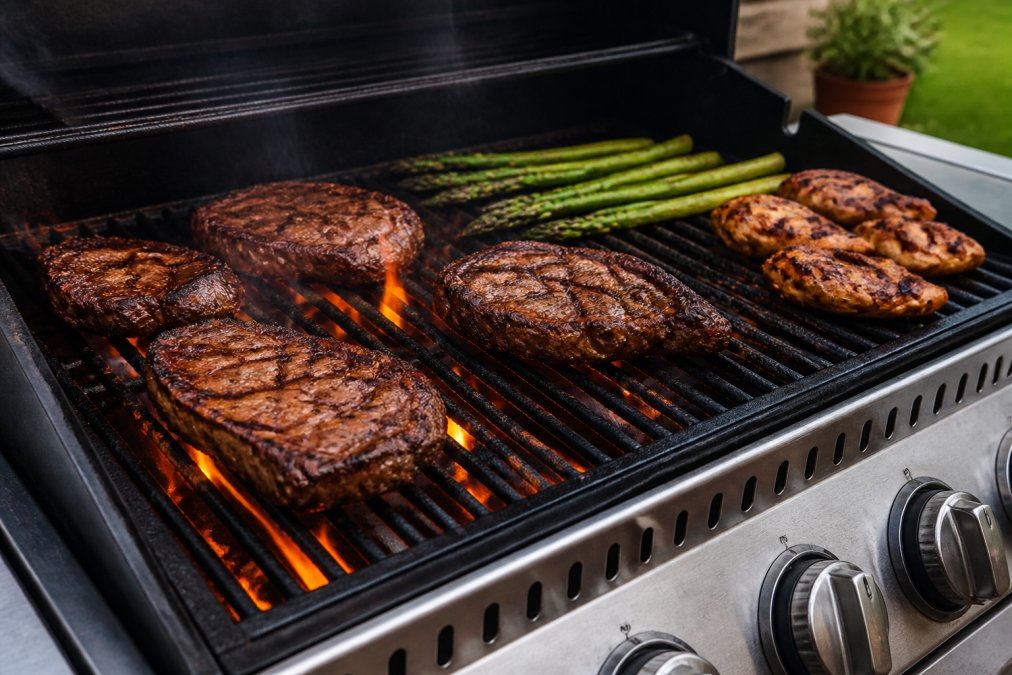
Gas Grill Grates
Gas grills use grates above the grill’s heat source. They can be a strong fit for cooks who prefer grate-based cooking for foods such as steaks, burgers, chicken, and vegetables. Heat behavior, grate material, searing capability, and indirect-cooking options vary by model, so review the product page and manufacturer documentation rather than assuming one grill’s features apply to another.
Grates leave openings beneath food, which affect smaller ingredients and allow drippings to pass through the cooking surface. That can suit many cooking styles, but it also means cleanup procedures and grease management are model-specific.
Griddle Flat-Top Surface
Gas griddles use a solid plate that keeps small ingredients on the cooking surface. That format can be a strong fit for breakfast, diced vegetables, fried rice, smash burgers, seafood, and other foods that benefit from a continuous surface.
Surface material, burner layout, heat response, grease management, and approved tools vary by model. Use the manufacturer’s instructions for operating, cleaning, conditioning, and storing the exact griddle you choose.
Match the Equipment to Your Meals
A grill may be the stronger first choice if your regular menu centers on grate-cooked proteins and vegetables. A griddle may be the stronger first choice if you frequently cook breakfast, cook smaller ingredients, or cook several foods at once on a single continuous surface.
Neither category is limited to a short list of meals. A covered griddle, a grill with accessories, or a particular burner layout may expand what a model can do. Compare the exact product and its approved accessories before deciding.
For some backyards, owning both makes sense: a grill for grate-based cooking and a griddle for flat-top meals. That is a preference decision, not a requirement.
Compare Workflow, Fuel, and Placement
Workflow is often the meaningful difference. On a grill, food placement and available burner controls shape how you manage the cook. On a griddle, the continuous surface changes how you stage and move ingredients. The number and layout of burners, available heat zones, and cooking-surface response are model-specific.
Fuel configuration also depends on the exact SKU. Propane may be supplied from a portable cylinder or, where the product and setup permit, a property-level propane supply. Natural gas availability varies by location and requires an appropriate source at the planned cooking site. Confirm the selected model’s fuel type and follow the manufacturer's instructions; do not assume that conversion or connection options are universal.
Plan for Cleaning and Care
Do not use a universal cleanup routine for every grill or griddle. The correct cooling state, approved scraper or brush, cleaning method, grease-tray procedure, conditioning steps, and storage guidance depend on the cooking surface and the manufacturer’s manual.
Before buying, review how the model handles grease and whether its manual calls for specific care products or protective steps. That is more useful than assuming that all grates, flat tops, stainless surfaces, or coated surfaces are maintained the same way.
Use This Decision Checklist
Compare the complete freestanding unit—not just the grill head or griddle plate. Measure the overall footprint with shelves, lid movement, and the working space you need around it. Follow the manufacturer’s placement and clearance instructions for the selected model.

| Compare | What to check |
|---|---|
| Cooking surface | Grates or a solid plate, plus the stated cooking area and material |
| Meal fit | The foods and cooking methods you use most often |
| Controls and features | The exact model’s burner configuration, lid, accessories, and approved use |
| Patio fit | Overall dimensions, shelf and lid clearance, traffic flow, and manual requirements |
| Care requirements | Manufacturer-approved cleaning, grease management, conditioning, and storage guidance |
Compare freestanding gas grills and gas griddles using the product details and owner documentation for each model.

Frequently Asked Questions
What is the main difference between a gas grill and a gas griddle?
A gas grill uses grates, while a gas griddle uses a continuous flat cooking surface. That difference affects how food is handled, how drippings are managed, and which meals feel most natural to cook.
Can a griddle replace a gas grill?
It can be the better primary tool for some cooking styles, but it does not create the same grate-based cooking experience. Choose based on the meals you make most often and the features of the exact model.
Which is easier to clean?
Care requirements vary by cooking surface and model. Review the manufacturer’s instructions for approved tools, cleaners, grease management, cooling state, conditioning, and storage.
How should I compare fuel options?
Confirm the selected SKU’s available fuel configuration and follow its manufacturer’s documentation. Fuel supply and connection requirements depend on the property, the product, and local conditions.