


Best Freestanding Grills for Backyard Entertaining
Table of Contents
- What Counts as a Freestanding Grill (and What Doesn't)
- Freestanding Grills vs. Built-In Grills
- Grills, Griddles, and Smokers Are Different Tools
- Match Outdoor Grill Cooking Capacity to Your Guest List
- Grill Burner Configurations and Heat Zones That Matter
- Propane vs Natural Gas Grills: Which Fuel Fits Your Property
- Side Shelves, Cart Storage, and Hosting Workflow
- Small-Space and Small-Yard Layouts
- Build Quality and Grill Manufacturer Warranties
- A Simple Decision Framework for Buyers
- Frequently Asked Questions
Last Updated: September 22, 2026
What Counts as a Freestanding Grill (and What Doesn't)
A freestanding grill is a complete cooking unit built onto its own cart, with the burners, hood, and fuel storage contained in one movable piece. That single definition separates it from almost everything else sold as outdoor cooking equipment. For general safety guidance on operating and maintaining a gas grill, the U.S. Consumer Product Safety Commission's gas grills fact sheet is a good starting point, alongside the manufacturer's own manual.
Freestanding Grills vs. Built-In Grills
Built-in grills are designed to drop into a masonry or cabinet structure. The structure carries the weight, hides the fuel, and defines the footprint permanently.
- Freestanding: movable, self-contained, no structure required, can be stored or covered
- Built-in: fixed, requires surrounding construction, usually part of a larger outdoor kitchen plan
Grills, Griddles, and Smokers Are Different Tools
A grill cooks over open grates with direct and indirect heat. A griddle cooks on a flat metal surface. A smoker holds low temperatures for hours.
| Equipment | Cooking Method | Typical Hosting Strength |
|---|---|---|
| Freestanding grill | Open grates, direct and indirect heat | Burgers, steaks, chicken, vegetables |
| Freestanding griddle | Flat surface, high heat | Breakfast, smash burgers, stir-fry, seafood |
| Smoker | Low, slow, indirect heat | Brisket, ribs, pulled pork |
Match Outdoor Grill Cooking Capacity to Your Guest List
Outdoor grill cooking capacity is measured in square inches of primary cooking surface, and the number matters less than what it feeds. A crowded grate steams instead of sears.
As a rough starting point, smaller grills (under about 400 square inches) tend to suit two to four people or weeknight cooking, mid-size grills (roughly 400 to 800 square inches) cover most weekend entertaining for four to ten people, and larger grills (800 square inches and up) are built for ten or more, or for cooking several dishes at once. Exact primary cooking area and total cooking area vary by model, so check the product page rather than assuming a category tells the whole story. Buying capacity for the biggest party of the year usually means a grill that is oversized for the other fifty weeks. Size for the typical gathering and let a warming rack or a second cook session handle the outliers.
Grill Burner Configurations and Heat Zones That Matter
Burner count determines how many heat zones a host can run at once, and that is the real specification to compare. Three burners let you sear on one side and hold food warm on the other.
What to look for in grill burner configurations:
- Independently controlled burners: each one lights and adjusts on its own
- Heat-zone separators: dividers that stop heat from bleeding between zones
- A sear station or high-output burner: useful for quick crusts on steaks
- A rear infrared burner: the standard setup for rotisserie cooking
- Ignition system: look for a named ignition type rather than a general claim
Burner count and heat-zone control matter more than raw BTU numbers. A host who can run two temperatures at once cooks a full meal; a host with one zone cooks in shifts.
Propane vs Natural Gas Grills: Which Fuel Fits Your Property
Fuel choice is the decision that is hardest to change later, because it shapes where the grill can sit, how it gets refueled, and how the cart is configured. The right answer depends on what already exists at the property and how the host plans to use the grill across a season.
| Factor | Propane | Natural Gas |
|---|---|---|
| Fuel storage | Tank carried in the cart | No tank on the cart |
| Portability | Can be rolled to different spots in the yard | Stays near the existing supply point |
| Refueling rhythm | Tank swaps or refills on the host's schedule | Continuous supply from the house line |
| Availability | Any property | Varies by property and utility service |
| Cart layout | Tank storage takes up part of the cart | More of the cart is available for storage |
| Configuration | Standard tank connection | Sold as a natural gas configuration or with a manufacturer conversion |
How Fuel Choice Changes Hosting
Propane rewards flexibility. A host who moves the grill between a patio, a deck, and a lawn corner, or who wants to store the grill out of the weather between gatherings, keeps that option open with a tank. The trade-off is refueling: a tank runs out mid-cook if it is not tracked, so many hosts keep a spare on hand during entertaining season.
What to Confirm Before Ordering
Availability varies by property, and confirming the connection is the homeowner's job before ordering. A few practical checks:
- Is there an existing supply point where the grill will sit? If not, natural gas may not be the right fit for that location.
- Which configuration is the product page selling? Many models are offered in propane and natural gas versions, and the product page states which one is in stock.
- Does the manufacturer publish a conversion? Some models support a manufacturer conversion kit; others are sold as one fuel type only. The product page and the manufacturer's documentation are the sources to check.
- How much cart storage does the host want? Removing the tank frees space, which matters for hosts who keep tools, covers, and platters in the cart.
Pick fuel by what is already at the property and how the grill will move during the season. Propane keeps the cart portable; natural gas keeps the cook uninterrupted. Confirm the connection and the configuration before ordering, because this is the one choice that is hardest to reverse.
Side Shelves, Cart Storage, and Hosting Workflow
Entertaining workflow is decided by the cart, not the firebox. Most guides stop at the feature list; the more useful question is how the cart supports the sequence of a cook when guests are already in the yard. Side shelves hold platters and tools, enclosed storage keeps the space clear, and the layout determines how many trips a host makes between the kitchen and the grill.
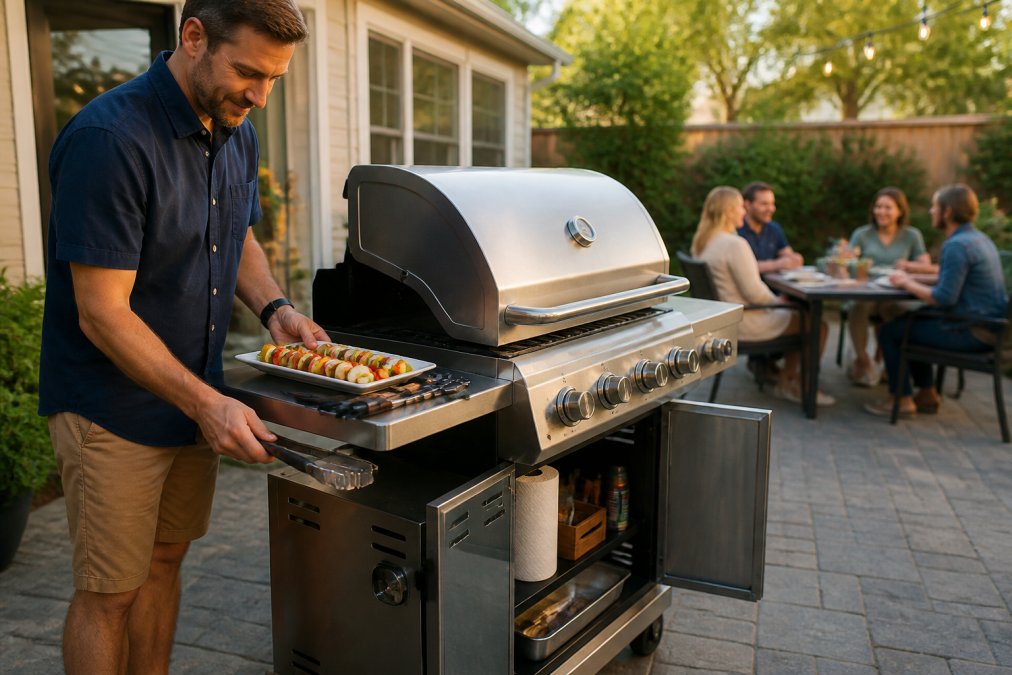
The Hosting Sequence, Mapped to the Cart
Think through a typical gathering in order, and check the cart against each step:
- Staging raw food. A side shelf gives raw proteins and vegetables a landing zone next to the firebox, separate from the platter that will hold finished food.
- Cooking in zones. Two shelves let the host keep a searing side and a holding side distinct, which matters when running more than one heat zone.
- Resting and plating. A second shelf or a warming rack gives finished food a place to rest before it goes to the table.
- Refueling mid-cook. A pull-out tank shelf or a magnetic door makes a tank change quick, which matters most when guests are already seated.
- Cleanup and storage. Enclosed drawers and cabinets keep tools, covers, and drip trays out of the weather so the next cook starts from a clear cart.
What to Check on the Cart
- Folding or fixed side shelves: folding saves space when the grill is not in use; fixed shelves give a more stable landing zone.
- Number of shelves: two shelves give a landing zone on both sides, which supports the staging and resting steps above.
- Enclosed storage: drawers and cabinets keep tools and covers out of the weather and off the patio.
- Tank access: a pull-out shelf or magnetic door makes tank changes easier, especially for propane carts.
- Casters, ideally locking: a heavy grill needs to stay put once positioned, and locking casters keep it from drifting during a cook.
- Interior lighting: useful for evening cooking, and it usually requires a nearby outdoor outlet.
Small-Space and Small-Yard Layouts
Not every hosting setup has a full patio. A few layouts that work when space is tight:
Galley layout: grill against a wall with a single folding shelf deployed, and a small prep table on the opposite side. The host works in a straight line.
Corner layout: grill in a corner with both shelves folded out, using the corner as the prep zone and keeping the walking path clear.
Roll-away layout: grill stored against the house and rolled out for gatherings, with a folding shelf on one side and a portable prep cart on the other. This suits renters and hosts who want the yard back between events.
Build Quality and Grill Manufacturer Warranties
Build quality shows up in the materials list and the warranty document, and those are the two places to look before comparing anything else.
Materials worth identifying by name:
- 304 stainless steel: the grade most often cited for outdoor cooking equipment
- Cooking grates: stainless steel rods, cast stainless, or cast iron, each with different heat behavior
- Firebox construction: gauge thickness is often published, and lower gauge numbers mean thicker steel
- Hood: double-lined or dual-lined hoods hold heat better than single-wall designs
A Simple Decision Framework for Buyers
Work through these steps in order. Each one narrows the field before the next question comes up.
- Count your typical guest list. Size the primary cooking surface to that number, not to your largest party.
- Decide grill, griddle, or smoker. Pick the one that handles your most common meal.
- Choose the fuel. Confirm what is available where the grill will sit before selecting a model.
- Set your minimum burner count. Three or more independently controlled burners covers most hosting.
- Check the cart. Two side shelves, enclosed storage, and locking casters.
- Read the materials list. Look for 304 stainless steel and a stated grate material.
- Read the warranty. Component coverage varies, and the details are in the document.
- Verify the specs on the product page. Configurations change between model years.
Frequently Asked Questions
What is the difference between a freestanding grill and a built-in grill?
A freestanding grill sits on its own cart with wheels, so it can be moved and does not require a built-in structure. A built-in grill drops into a masonry or cabinet surround that is planned and built around it. Freestanding grills are the simpler choice when you want flexibility, storage in the cart, and the ability to reposition the grill for parties. Built-in setups are fixed and usually part of a larger outdoor build.
How do I determine the right cooking capacity for my backyard grill?
Start with your typical guest count and add a buffer. Primary cooking surface, warming rack space, and total square inches all vary by model, so check the product page rather than assuming a burner count tells the whole story. If you often host 8 to 12 people and cook sides alongside the main, a larger primary surface plus a warming rack gives you room to work in stages instead of crowding everything at once.
What should I consider when choosing between propane and natural gas for my grill?
Availability varies by property. Propane works anywhere because it runs from a tank, which also means you manage refills. Natural gas requires an existing supply line at the grill location, so confirm what your property has before choosing a configuration. Both fuel types appear across freestanding gas grills, and the right answer usually comes down to what is already available where the grill will sit.
Why is burner count important for outdoor entertaining?
Burner count and heat-zone separators determine how many different temperatures you can run at once. More independently controlled zones let you sear steaks on one side, hold vegetables on another, and keep a sauce warming without juggling the whole surface. For entertaining, that flexibility matters more than raw burner count, so look at how zones are divided, not just how many burners a model lists.
Matching a freestanding grill to how you actually host comes down to guest count, fuel, and a cart that keeps the workflow moving once people arrive. Backyard Kitchens Direct carries a range of freestanding gas grills across burner counts, fuel types, and cart configurations, shipped to the lower 48 states.


