


How to Maintain Outdoor Kitchen Stainless Steel
Table of Contents
- Why Stainless Steel Care Starts With the Manufacturer's Instructions
- Stainless Steel Cleaning Best Practices for Outdoor Kitchens
- Reading Manufacturer Stainless Steel Maintenance Guidelines
- A Simple Outdoor Kitchen Stainless Steel Care Routine
- Cleaning Products and Tools: What the Label Has to Say
- Common Mistakes That Undo Stainless Steel Care
- When Routine Care Is Not Enough: Checking With the Manufacturer
- Explore Backyard Cooking Options
- Frequently Asked Questions
Last Updated: September 17, 2026
Why Stainless Steel Care Starts With the Manufacturer's Instructions
Stainless steel is not a single material with a single set of care rules. It is a family of alloys, and how to maintain outdoor kitchen stainless steel depends entirely on which alloy and finish a given product uses. This guide from Backyard Kitchens Direct covers routine care that official manufacturer documentation supports, and it starts with the step most owners skip: reading the care guidance that shipped with the product.

Stainless Grades and Finishes Are Not Interchangeable
Stainless grades differ in composition, and finishes differ in texture, from brushed to polished to a matte grain. Manufacturer care instructions are written around those differences, which is why a universal cleaning rule does not exist.
Stainless Steel Cleaning Best Practices for Outdoor Kitchens
The most reliable stainless steel cleaning best practices are the ones printed in the owner's manual for the specific product. General habits help, but they never override model-specific instructions. Routine care, done consistently and gently, prevents most of the buildup that leads to stubborn staining.
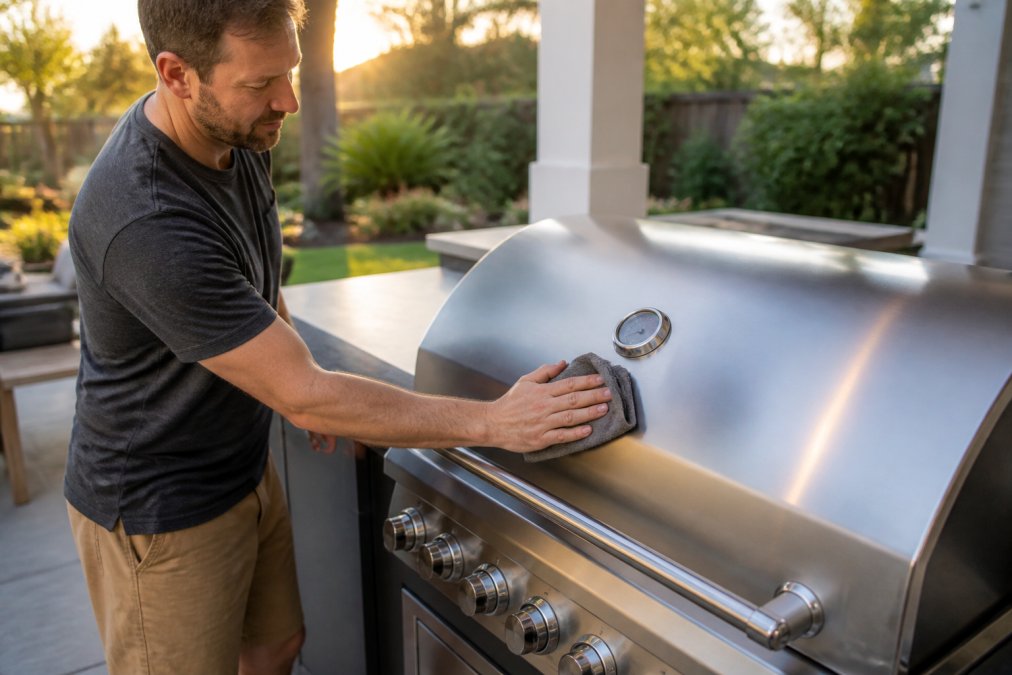
Routine Wiping After Cooking
Wiping the cooking surface and exterior after the equipment cools removes food residue, grease, and moisture before they set. Manufacturer guidance typically describes wiping with a soft cloth and a mild solution, then drying the surface. Leftover moisture and residue are the conditions that allow surface staining to develop. A quick wipe after each use is easier than a deep clean later.
What to Check Before You Use Any Product
Before applying anything to a stainless surface, check three things: the owner's manual for approved cleaners, the product label for the surfaces it is intended for, and the finish type on the equipment. Abrasive pads, steel wool, and harsh chemicals can scratch or dull a finish even when the underlying alloy is unaffected. If a product's label does not list stainless steel as a suitable surface, do not use it.
Using an abrasive pad or an unapproved cleaner on a brushed stainless finish can leave permanent scratches that no amount of polishing will remove. Check the owner's manual before the first wipe, not after the damage is visible.
Reading Manufacturer Stainless Steel Maintenance Guidelines
Manufacturer stainless steel maintenance guidelines exist because grades, finishes, and assemblies vary from product to product. Treat them as the primary source, not a suggestion. The manual for a given model tells you which cleaners are approved, which tools are safe, and how often the maker recommends attention.
A Simple Outdoor Kitchen Stainless Steel Care Routine
A workable outdoor kitchen stainless steel care routine is short and repeatable. It has three parts: wipe after use, inspect the surface periodically, and deep clean only as the manufacturer directs. The routine matters more than any single product, because most surface problems develop slowly and are easier to prevent than to reverse.
Why Each Step Matters
Wipe after use. Food residue, grease, and moisture are the three things that most often lead to surface staining on outdoor stainless. When they sit on the surface, they hold moisture against the metal and can leave marks that a later wipe will not remove. Wiping the cooled surface with a soft cloth and drying it removes those conditions before they set.
- Residue or grease that has dried in place, especially along seams, handles, and lid edges
- Standing moisture in low spots or around fasteners
- A change in the finish, dulling, darkening, or a mottled look that wiping does not correct
- Any texture change, such as a rough spot where the surface was previously smooth
| Stage | What to Do | When |
|---|---|---|
| After cooking | Wipe the cooled surface with a soft cloth and dry it | After each use |
| Periodic check | Look for residue, moisture, or finish changes | On a regular schedule |
| Deep clean | Follow the owner's manual for approved cleaners and methods | Only as directed |
A Note on Off-Season Storage
One of the most common patterns owners report is that a surface looks fine at the end of the season and shows staining the next time it is uncovered. The cause is usually the same: residue or moisture left in place when the equipment was covered. Before storing any stainless piece for an extended period, follow the manufacturer's guidance for end-of-season care, and confirm what the manual says about covers and ventilation.
Keep the owner's manual for every piece of stainless equipment in one place, digital or physical. When a cleaner or tool is in question, the answer is usually already in that file, and it takes seconds to check.
The routine is not the product. Wipe, inspect, and deep clean only as directed, and treat any finish change you cannot correct with a soft cloth as a question for the manufacturer, not a cue to escalate.
Cleaning Products and Tools: What the Label Has to Say
The label on a cleaning product is the fastest way to know whether it belongs near stainless steel. A label that does not list stainless as a suitable surface is a stop sign. A label that does list it may still carry warnings about finishes, so read the full text rather than the headline claim.
Common Mistakes That Undo Stainless Steel Care
Most stainless problems trace back to a handful of avoidable habits. The first is using an abrasive tool because it works faster. The second is leaving residue or moisture on the surface instead of drying it. The third is applying a cleaner without checking whether the manufacturer approves it for that model.
When Routine Care Is Not Enough: Checking With the Manufacturer
Some surface conditions fall outside routine care. The useful skill is telling apart the ones that are cosmetic from the ones that suggest something deeper, and knowing that in either case, the manufacturer is the right source for what to do next.
Reading the Surface: Cosmetic vs. Deeper Conditions
Most guides skip this step, but it is the one that decides whether a soft cloth is enough or whether the question belongs with the manufacturer. Use the descriptions below as a starting point, not a diagnosis.
Often cosmetic (start with routine care):
- A dull or slightly darkened area that wipes down but returns
- Fingerprint-like smudges or water spots that follow the pattern of use
- A light film along a lid edge, handle, or seam
- Discoloration that is uniform across a panel and has no texture change
Worth a closer look (document and ask the manufacturer):
- A rough or pitted texture where the surface was previously smooth
- Dark specks or spots that do not change with gentle wiping
- Staining that returns immediately after the first cook following a cleaning
- A finish change confined to one area, especially near a seam, fastener, or heat-affected zone
- Any area where the surface feels different from the surrounding metal
If a Problem Returns After Cleaning
A condition that comes back right after the first cook is a signal, not a failure of effort. The common pattern is that the underlying cause was never addressed, residue left in a seam, moisture trapped under a cover, or a cleaner that was not approved for that finish. Before trying anything stronger, re-read the owner's manual for the specific model, confirm the cleaner and tool you used are approved, and check whether the surface was fully dried.
What Not to Do
Escalating to abrasives or harsh chemicals without manufacturer guidance is the single most common way a cosmetic issue becomes permanent. Abrasive pads and steel wool can alter a brushed or polished finish in a way no later step will reverse. A cleaner that is not listed for stainless on its own label is not a candidate, regardless of what it is marketed for.
If a condition involves a rough or pitted texture, do not attempt to smooth it with an abrasive. Document it and contact the manufacturer for its recommended approach. The finish on the surrounding metal is what is at risk.
Cosmetic conditions get routine care. Deeper conditions get documentation and a call to the manufacturer. The line between them is texture and persistence, if the surface feels different or the problem returns immediately, it is no longer a routine-care question.
Explore Backyard Cooking Options
Backyard Kitchens Direct is a veteran-owned online retailer of premium outdoor cooking equipment, including freestanding gas grills, freestanding gas griddles, smokers, and modular outdoor kitchen islands. Every product ships with its own manufacturer documentation, and that documentation is the starting point for care. Browse the collection and choose equipment with the guidance you need to maintain it.

Frequently Asked Questions
Why do manufacturer care instructions vary for stainless steel?
Stainless steel is a family of alloys, not a single material. Grades, surface finishes, and how a piece is formed all differ between products, and each manufacturer tests and documents care for its own build. A cleaner that suits one grill or island may be wrong for another. That is why the care guidance shipped with your specific outdoor kitchen stainless steel product should be your first reference, ahead of any general advice you find online.
How can I find the specific maintenance guide for my outdoor equipment?
Start with the paperwork that came with the product, then check the manufacturer's website for a downloadable owner's manual or care sheet. Look for the model number on the unit itself, since guides are usually organized by model. If you cannot find the document, contact the manufacturer directly and ask which cleaning products and methods it approves for your unit before you try anything.
What are the risks of using unverified cleaning methods on stainless steel?
Unverified methods can scratch a brushed finish, leave residue that traps moisture, or react with the surface in ways the manufacturer never approved. Some of the most common home remedies circulate widely online without any product-specific testing behind them. If a method is not named in your product's care documentation, treat it as unproven. The safer path is to follow the manufacturer's instructions and ask them directly when you are unsure.
How does the finish of stainless steel affect routine maintenance?
Finish changes how a surface should be touched. Brushed and grained finishes are typically wiped along the direction of the grain to avoid visible marks, while polished surfaces show smudges differently and may call for a different cloth or technique. Because finishes vary by product, the manufacturer's guidance for your specific unit is the only reliable source for how to wipe, rinse, and dry it between uses.


