


Propane Grill Safety Tips for Homeowners: 2026 Guide
Table of Contents
- Why Propane Grill Safety Starts Before You Light It
- Setting Up Your Grill: Clearance, Placement, and Ventilation
- Propane Grill Leak Test Procedure: A Step-by-Step Check
- How to Store Propane Tanks Safely Between Cooks
- Lighting, Cooking, and Shutting Down Without Incident
- Your Propane Grill Maintenance Checklist for the Season
- Grill Fire Safety Tips and Emergency Response
- Frequently Asked Questions
Last Updated: September 14, 2026
Why Propane Grill Safety Starts Before You Light It
Propane grill safety is the set of habits, checks, and inspections that keep a gas grill operating as designed, and most happen before the igniter clicks. This guide from Backyard Kitchens Direct covers placement, leak testing, tank storage, lighting, shutdown, and seasonal maintenance. Confirm every step against your grill's manufacturer manual and your local fire code office, since requirements vary.
The pre-light routine matters because propane is heavier than air, so a leak near the tank or hose settles low and collects rather than dispersing. A grill that sits unused for weeks also gives spiders and insects time to nest inside burner tubes, a common cause of uneven ignition and flare-ups.
The two highest-value habits are a soapy water leak test before the season starts and a burner tube inspection after any long storage period. Both are quick, worthwhile checks.
Setting Up Your Grill: Clearance, Placement, and Ventilation
A propane grill belongs outdoors only, on a flat, level surface, with the lid and vents unobstructed.
Choosing a Flat, Level Surface
A level surface keeps the grill from tipping and keeps grease flowing into the drip tray instead of pooling against a hot burner. Decks, patios, and paved areas work if stable. Grass, gravel, and sloped ground do not, because the legs can shift under load.
Keeping Distance From Combustible Materials
Manufacturers publish clearance distances in the manual, and those numbers matter for your specific grill. They typically address distance from walls, railings, siding, and overhead structures. The general principle is consistent: keep the grill away from combustible materials on all sides, never place it under a roof overhang or low branches, and never operate it in a garage, shed, tent, or enclosed space. Before positioning a grill permanently, confirm the required clearances in the manual and check with your local fire code office.
Propane Grill Leak Test Procedure: A Step-by-Step Check
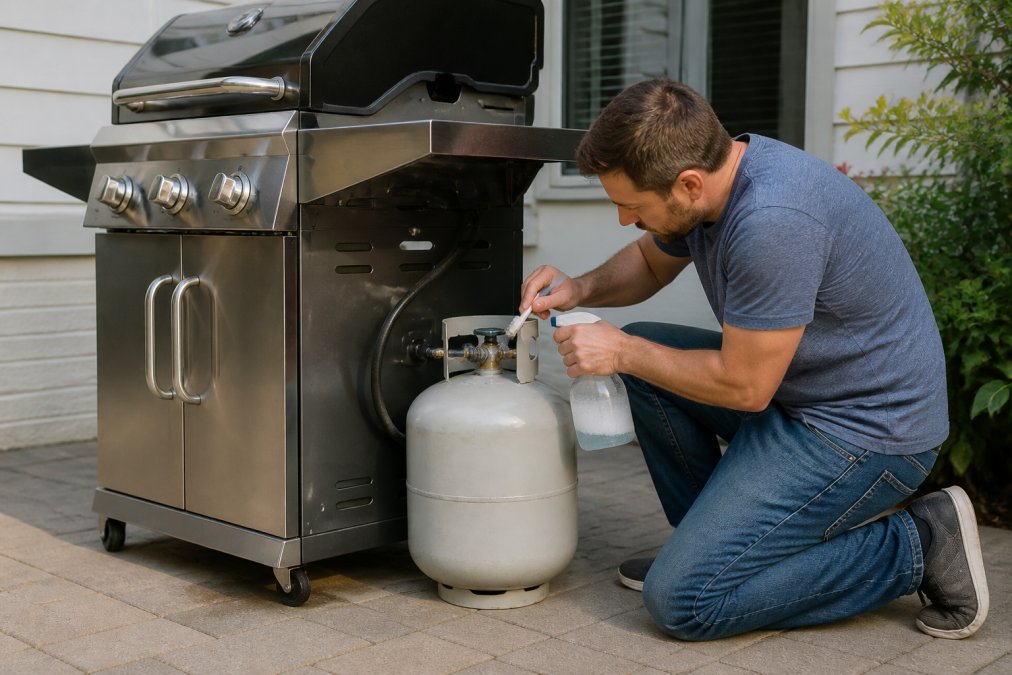
A propane grill leak test procedure is a soapy water check on every connection between the tank and the burners, with the grill off and the lid open. It takes a few minutes and is the most useful habit here.
The Soapy Water Test on Hoses, Regulator, and Valve
Mix liquid dish soap with water in a spray bottle or brush it on. With the tank valve open and burner controls off, apply the solution to each connection:
- The joint where the regulator meets the propane cylinder valve
- The full length of the hose, paying attention to bends and any spot where it rubs against the cart
- The connection where the hose meets the grill's manifold
- The cylinder valve itself, around the stem and the collar
Growing bubbles mean gas is escaping. Check the manufacturer manual for the exact test sequence your grill requires, and follow its leak-response instructions rather than improvising.
What to Do If You Smell Gas
Stop. Do not attempt to light the grill, and do not operate any electrical device nearby. Shut the cylinder valve if you can reach it safely, move away from the area, and keep people clear until the smell dissipates. If the odor is strong or persists, leave the property and call 911 or your local fire department from a safe location. The National Fire Protection Association publishes guidance on propane and gas appliance emergencies that reinforces this sequence.
Never use a flame to check for leaks. A lighter or match near a leaking connection is how minor gas escapes become injuries.
How to Store Propane Tanks Safely Between Cooks
Knowing how to store propane tanks safely matters as much as the cooking routine, because an idle cylinder is where many residential problems begin. Keep the cylinder upright, outdoors, away from anything that can ignite it, and visible enough to check its condition.
Why Upright and Outdoors Is the Baseline
Propane is heavier than air. If a cylinder leaks, the gas settles low and collects in the lowest available space rather than dispersing, which explains almost every storage rule. A basement, garage, shed, or vehicle traps that low-lying gas where it can reach an ignition source; an open, well-ventilated outdoor spot lets it dissipate. Store cylinders upright so the relief valve and valve assembly stay in their designed position.
Where to Put the Cylinder Between Cooks
- Outdoors, in a well-ventilated area, out of direct sun
- Away from heat sources, open flames, and any ignition source
- Away from the grill itself, not tucked against a warm firebox
- Out of reach of children and pets
- Not directly beside a spare cylinder that is also in use
Disconnect the cylinder from the grill when not in use, and cap the valve outlet if the manufacturer supplies a plug or cap. A capped valve keeps dirt, insects, and moisture out and makes it obvious the cylinder is not connected. Local storage rules vary, so confirm specifics with your fire department or propane supplier.
Seasonal Storage and Winterization
Cold weather does not make a propane cylinder safer or inert. A cylinder stored through a freeze-thaw cycle can see its valve and collar take on moisture, and a grill left uncovered through a wet winter is a grill with a corroded regulator by spring. For off-season storage:
- Disconnect the cylinder from the grill and cap the valve outlet.
- Store the cylinder upright, outdoors, in a ventilated spot out of direct sun.
- Cover the grill only after it has fully cooled, and use a cover that lets air move rather than trapping condensation.
- Store the grill itself in a dry, sheltered spot if you have one.
- Before the next season, inspect the hose, regulator, and burner tubes before you reconnect anything.
If a cylinder is damaged, dented, corroded, or past its inspection date, do not refill it. Take it to a qualified propane supplier and follow their instructions for disposal or exchange. Never force a valve.
Moving a Cylinder Without Creating a Problem
A full cylinder is heavy, and most handling injuries happen during transport, not cooking. Keep the cylinder upright while moving it, use the collar or handle rather than the valve, and secure it so it cannot roll or tip in a vehicle. Do not leave a cylinder in a closed vehicle on a warm day, and do not transport one with the valve open. If exchanging a cylinder, let the supplier handle the connection.
Never store a propane cylinder indoors, in a garage, in a shed, or in a vehicle, even briefly. A leak in an enclosed space is the scenario the storage rules exist to prevent.
A cylinder that is upright, outdoors, capped, and out of the sun is doing its job. If you cannot see the cylinder and the valve, it is probably in the wrong place.
Lighting, Cooking, and Shutting Down Without Incident
The lighting and shutdown sequence is where small errors cause the most trouble. Follow the manual's order of operations every time, even for a quick weeknight cook.
Ignition Steps and Lid Safety
Open the lid before lighting; gas that accumulates under a closed lid can ignite suddenly when the burner catches. Confirm all burner controls are off, open the cylinder valve slowly, then turn on one burner and use the igniter as the manual directs. If the burner does not light within a few seconds, turn it off, wait for the gas to clear, and try again. Treat the lid as a thermal barrier, not a place to rest hands or tools.
Pre-Heating and Managing Flare-Ups
Pre-heating with the lid closed brings the grates to temperature and burns off residue from the last cook. Flare-ups come from grease and fat buildup, not propane itself. Trim excess fat before grilling, keep the drip tray and grease management parts clean, and move food away from the flame zone if a flare-up starts. If it will not settle, close the lid, turn off the burners, and leave it closed until the flames die down.
Your Propane Grill Maintenance Checklist for the Season
A propane grill maintenance checklist keeps safety-critical parts in working order. Run through it at the start of the season and again before storing the grill.
- Inspect the hose for cracking, brittleness, or abrasion, and replace it if damaged
- Check the regulator for corrosion or a loose fit at the tank
- Remove burner tubes and clear spider webs, insect nests, and other blockage from the ports
- Clean grease buildup from the drip tray, grease tray, and firebox
- Inspect the ignition system and replace the battery or electrode as needed
- Verify the cylinder valve, collar, and foot ring are undamaged
- Confirm the grill sits level and that nothing combustible has drifted under or beside it
For seasonal storage and winterization, disconnect and store the cylinder per the rules above, cover the grill once it has cooled, and store it in a dry, sheltered spot. A covered grill that sits through a wet winter is a grill with a corroded regulator in spring. The U.S. Consumer Product Safety Commission maintains recall and safety information for outdoor cooking appliances worth checking against your model.
Grill Fire Safety Tips and Emergency Response
Most grill safety guides stop at prevention. This section covers what to do when something goes wrong, because the first thirty seconds of a grill fire decide whether it stays a flare-up or becomes an emergency. These are general response principles; your manufacturer manual and local fire department are the authorities for your grill and jurisdiction.
Before the Fire: What to Have Within Reach
- A fire extinguisher rated for the types of fire a propane grill can produce, kept within reach of the cooking area and checked so you know it is charged
- A clear path away from the grill, with nothing stored between you and the exit
- A phone you can reach without going back toward the grill
- The cylinder valve location memorized, so you are not searching for it under pressure
Know how to use the extinguisher before you need it. The pass technique (pull the pin, aim at the base, squeeze the handle, sweep side to side) is worth reviewing once a season.
Step-by-Step: If a Fire Starts
- Stay calm and assess. Is the fire at the cooking surface, or is it at the tank connection? The answer changes what you do next.
- If the fire is at the cooking surface and contained: turn off the burner controls, close the lid if it is safe to do so, and let the fire starve of oxygen. Do not open the lid to check.
- If the fire is at the tank connection: shut the cylinder valve only if you can reach it without putting yourself in danger. If you cannot, do not try.
- If the fire will not settle, or you cannot safely reach the valve: evacuate. Move people away from the grill, get to a safe distance, and call 911 from a safe location.
- If the fire is spreading to a structure or the cylinder is involved: evacuate immediately and call 911. Do not attempt to fight it.
What Not to Do
- Never use water on a grease fire. Water spreads burning oil and can turn a contained fire into a much larger one.
- Never move a grill that is on fire. A burning grill can tip, and a propane cylinder that is involved in a fire is not something to relocate.
- Never assume a fire is out because the flames are gone. Grease and hot metal can reignite. Leave the grill closed and let it cool completely before you go near it.
- Never light a grill after a fire until the cause has been identified and the affected parts have been inspected.
Smart Grill Technology and Emergency Response
Remote monitoring, app-controlled burners, and automatic shutoff features are convenient, but they do not replace a physical inspection or change the response steps above. If a controller reports a fault, or a burner will not respond, shut the cylinder valve and treat it as a gas issue until confirmed otherwise. An app that says the grill is off is not the same as a valve you closed by hand.
After Any Fire: What to Check Before the Next Cook
Once the grill has fully cooled, inspect the hose, regulator, burner tubes, and the area around the tank connection before using it again. A fire can damage a hose or leave debris in a burner tube, the conditions that cause the next incident. If you are not confident in what you are looking at, have the grill inspected by a qualified professional before the next light.
If you are coming from a charcoal grill, expect the learning curve to run the other direction: gas responds instantly, so a flare-up escalates faster and the correct reaction is to cut the burners, not to move the food.
Prevention keeps most fires from starting. Knowing the response steps keeps a small fire from becoming a large one. Review both before the season, not during it.
For homeowners planning a larger cooking setup, Backyard Kitchens Direct carries freestanding gas grills, freestanding gas griddles, smokers, and modular outdoor kitchen islands, along with planning guidance to match equipment to your space.

Frequently Asked Questions
How close can a propane grill be to a house?
Clearance distances vary by manufacturer and local fire code, so there is no single universal number. Check your grill's owner's manual for the manufacturer's stated minimum, then confirm with your local fire code or permit office before you position the grill. As a general practice, keep the grill on a flat, level surface away from combustible materials, and never operate it under an overhang or in an enclosed space. A freestanding gas grill placed in an open, well-ventilated area gives you the most flexibility.
How do I check my propane grill for leaks?
The propane grill leak test procedure is simple: with the burner controls off, turn the propane cylinder valve on, then apply a soapy water solution to the hose, regulator, and valve connections. If bubbles form and grow, you have a leak. Turn the cylinder valve off immediately and tighten or replace the affected part per the manufacturer's instructions. Never use a flame to check for leaks. Repeat the test after any tank change, hose replacement, or long storage period.
What should I do if I smell gas while grilling?
Turn off the burner controls and the propane cylinder valve right away. Do not try to relight the grill. Move people away from the area and let the gas dissipate before you investigate. Once clear, inspect the hose and connections using the soapy water test. If the smell persists or you cannot find the source, leave the grill off and contact your local fire department for guidance. Never ignore a gas smell or assume it will clear on its own.
How should I store propane tanks safely when the grill is not in use?
Store propane cylinders upright in a well-ventilated outdoor area, away from heat sources, direct sun, and combustible materials. Keep the cylinder valve closed and the cap or plug in place when the tank is not connected to the grill. Never store a propane tank indoors, in a garage, or in a car trunk. For seasonal storage, disconnect the tank, check the hose for cracking, and follow your manufacturer's guidance for winterizing the grill itself.


