Insulated Grill Jackets and Zero Clearance Liners
Table of Contents
- Do You Need an Insulated Jacket for a Built-In Grill?
- Combustible vs. Non-Combustible Construction
- What Clearance to Combustibles Means
- What the Manuals Say, Brand by Brand
- What a Jacket or Liner Does Not Replace
- Planning Checklist Before You Frame the Island
- Frequently Asked Questions
Last Updated: October 26, 2026
Do You Need an Insulated Jacket for a Built-In Grill?
It depends on how your island is built and on what your grill's installation manual says. If the island frame or cabinet is made of combustible material, such as wood studs, the manufacturer may require a non-combustible enclosure, a set clearance from the framing, or a matching insulated grill jacket or zero clearance liner. The manual for your exact grill decides which, along with your local building and fire codes.
That last part matters. Jackets and liners are not universal parts, and brands don't all treat them the same way. This guide explains the terms, shows what two of the manuals we carry actually say, and gives you a checklist to work through before anyone frames the island.
Combustible vs. Non-Combustible Construction
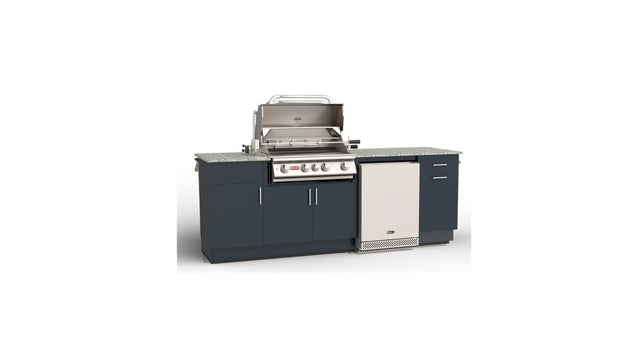
A built-in gas grill drops into a cutout in an outdoor kitchen island. Unlike a freestanding grill on its own cart, it sits inside a structure, so the materials around it matter.
- Combustible construction means materials that can catch fire or char from heat. Wood studs, plywood, and wood trim are the common examples in island builds.
- Non-combustible construction means materials that won't burn. Masonry and concrete block are typical. Wildfire's grill manual, for example, describes its built-in grills as designed for installation into masonry enclosures.
Some boards and panels sit in a gray area. A board or panel's rating decides if it counts as non-combustible, so check its listing and your local code rather than going by appearance. A stone veneer over a wood frame is still a wood frame.
What Clearance to Combustibles Means
A clearance is the minimum distance a manufacturer requires between its grill and a given material. A gas grill puts out a lot of heat, and not all of it goes straight up. Wildfire's manual, for example, notes that its grills vent mainly through the rear of the unit, below the top of the hood. Clearances keep that heat away from materials that could ignite.
Clearance figures are set per model and written into each installation manual. They can differ between the back and the sides, between combustible and non-combustible materials, and between brands. That's why this guide doesn't give a single "safe" number. The only number that counts is the one in the manual for the grill you're installing.
An insulated jacket or zero clearance liner is a fitted enclosure that sits between the grill and the island. It goes into the cutout, and the grill is installed inside it. Each one is made for a specific grill model and size. Where the manufacturer designs and approves it for that purpose, it lets you build closer to combustible framing than the grill alone would allow.
What the Manuals Say, Brand by Brand
Here's what the installation documents for two built-in lines we carry say about combustible islands. Everything below is quoted or paraphrased from the manufacturer documents named in each row. These documents are linked in the Manuals tab on each product page.
| Grill | Combustible island frame | Jacket or liner | Source |
|---|---|---|---|
| Napoleon Built-In 700 Series | The cabinet frame and cabinet must be non-combustible unless the grill is installed with its matching Zero Clearance Liner. | Zero Clearance Liner made for each grill size. The cutout changes when the liner is used. | Napoleon Built-In Series Owner's Manual (N415-0788); Built-In Series Assembly Guide (N415-0602) |
| Wildfire Ranch Pro | At least 24 inches of clearance from any combustible materials, in any direction, for safety and for the Wildfire warranty to stay in effect. | Insulated Jacket sized for each Ranch Pro grill, griddle, and burner, with its own cutout. It does not allow installation directly against combustible framing; the manual's clearances still apply. | Wildfire Grill Instructional Manual; Wildfire Built-In Specifications; confirmed with our Wildfire distributor (October 2026) |
Napoleon Built-In 700 Series
Napoleon's position is the clearest of the two. Its Built-In Series Owner's Manual includes this warning next to the cutout chart: the cabinet frame and the cabinet must be made from non-combustible material when the grill is not installed with the Zero Clearance Liner made for that unit.
In other words, for a wood-framed island, Napoleon's manual points you to the liner. The same chart gives two sets of cutout dimensions, one for the grill alone and one for the grill installed with the liner, so the liner decision has to be made before the island is framed. Napoleon's Built-In Series Assembly Guide lists the zero clearance liners as accessories by grill size.

We carry the Napoleon Zero Clearance Liner for Built-In 700 Series 44-Inch Grill, made for the 44-inch size of the Napoleon Built-In 700 Series Gas Grill. Its product page lists the cutout with the liner. Planning a 38-inch Napoleon in a combustible island? Call us before you build so we can confirm the right liner for that size.
Napoleon's manual has a few more rules that apply with or without the liner. It says not to operate the grill under any combustible construction, lists minimum distances to combustibles behind and beside the grill, and requires the gas hook-up to be done by a licensed gas fitter and leak tested before the grill is used. Read those sections in full before you finalize the layout.
Wildfire Ranch Pro
Wildfire's Grill Instructional Manual handles combustible materials with a clearance rule rather than a liner rule. It says Wildfire grills must have at least 24 inches of clearance from any combustible materials, in any direction, for the safety of the homeowner and for any Wildfire warranty to remain in effect. It also describes the built-in grills as designed for masonry enclosures.
Wildfire does make the Wildfire Insulated Jacket in a version for each Wildfire Ranch Pro built-in gas grill size, plus versions for the Ranch Pro griddles and power burner. Wildfire's Built-In Specifications sheet lists a separate cutout for each jacket. The jacket does not let you install the grill directly against combustible framing. When we asked our Wildfire distributor in October 2026, the answer was clear: you still have to keep the clearances in the Instruction/Owner's Manual.

One more thing to know: the 2026 Wildfire catalog's gas grill page lists a 36-inch figure, which differs from the manual. The spec to build to is the one in the owner's manual. Our Wildfire distributor told us that brochures and catalogs are not meant as installation instructions, and that inspectors and installers go by the technical documentation in the owner's manual. If you're planning a Wildfire grill anywhere near combustible framing, call us before you build.
Other Built-In Grills
We carry built-in grills from several other brands, and each one has its own installation manual with its own clearances, cutouts, and rules for combustible construction. Don't assume one brand's answer carries over to another. Open the Manuals tab on the product page for the grill you're considering and read the installation section before you buy the island materials.
What a Jacket or Liner Does Not Replace
A liner solves one problem: heat reaching the island frame. The manuals list other requirements that still apply.
- Overhead structure. Napoleon's manual says not to operate the grill under any combustible construction. Wildfire's manual says the grill can't go under combustible material without an approved ventilation hood directly above it, and spells out what Wildfire counts as approved.
- Island ventilation. Wildfire's manual requires at least two vents, and optimally four, in any island cabinet that has a gas supply or connection, each at least 20 square inches with access to fresh air. Vent placement depends on the fuel: low for propane, high for natural gas.
- Propane tank storage. Both manuals have rules for storing a propane cylinder in an island. Wildfire says it must sit in its own vented compartment, separate from the grill. Napoleon's manual has its own built-in cylinder enclosure instructions.
- Gas and electrical work. Napoleon requires a licensed gas fitter for the hook-up, and Wildfire strongly recommends professional installation. Napoleon's manual also says a rotisserie motor must be electrically grounded in accordance with local codes. Use a qualified, licensed installer for gas lines and any electrical work.
- Local codes. Both manuals say installation must follow local codes, and fall back to the National Fuel Gas Code (ANSI Z223.1/NFPA 54) where no local code applies. Your local building or fire department has the final say.
Planning Checklist Before You Frame the Island
- Choose the grill first. Pick the exact brand, model, and size. Clearances and cutouts belong to the model, not the category.
- Download and read the installation manual. Find the sections on clearances, combustible construction, cutouts, and ventilation. The Manuals tab on our product pages links to them.
- Decide on your island framing. If it will be wood or another combustible material, find out if the manual allows that at all, and with which jacket or liner.
- Use the right cutout. If a jacket or liner is used, the island opening is built to its cutout, not the grill's. Napoleon and Wildfire both publish separate jacket or liner cutouts.
- Check what's above the grill. Pergolas, roof overhangs, and covered patios all count. Follow the manual's overhead rules.
- Plan vents and gas access. Vent the cabinets as the manual requires and keep the gas shut-off easy to reach.
- Check local code and permits. Ask your building department what applies to an outdoor kitchen with gas where you live.
- Hire qualified installers. A licensed gas fitter for the gas connection and a licensed electrician for any wiring.
- Ask before you build if anything is unclear. If two documents disagree, or the manual doesn't cover your situation, get it answered before the frame goes up.
If you're still deciding between a freestanding gas grill and a built-in grill, our guide to freestanding gas grills vs. built-in grills covers the tradeoffs.
Frequently Asked Questions
What is an insulated grill jacket?
An insulated grill jacket, also called an insulated liner or zero clearance liner, is a fitted enclosure that sits in the island cutout between the island and the built-in grill. Napoleon's Zero Clearance Liner, for example, is stainless steel. Each one is made for a specific grill model and size, and it has its own cutout dimensions.
Can I put a built-in grill in a wood-framed island?
Only if the grill's installation manual allows it. Napoleon's Built-In Series Owner's Manual requires a non-combustible cabinet unless the grill is installed with its matching Zero Clearance Liner. Wildfire's grill manual requires at least 24 inches of clearance from combustible materials in any direction. Follow the manual for your exact grill and your local codes.
Is a zero clearance liner the same as an insulated jacket?
They're similar parts with different names, and what they're approved for depends on the brand. Napoleon's manual ties its Zero Clearance Liner directly to installing in a combustible cabinet. Wildfire's Insulated Jacket does not allow installation directly against combustibles; the clearances in Wildfire's manual still apply. Check the manual rather than going by the product name.
Does a liner change the island cutout size?
Yes, for both brands covered here. Napoleon's manual lists a separate cutout for the grill installed with the liner, and Wildfire's Built-In Specifications sheet lists separate cutouts for each insulated jacket. Decide on the liner before the island is framed.
Who should install a built-in gas grill?
Napoleon's manual requires a licensed gas fitter for the gas hook-up and a leak test before use, and Wildfire strongly recommends professional installation. Use qualified, licensed installers for gas and electrical work, and check with your local building department about codes and permits.
Backyard Kitchens Direct carries the Napoleon Zero Clearance Liner for the 44-inch Built-In 700 Series grill and the Wildfire Insulated Jacket in sizes for the Ranch Pro line. Not sure what your island needs? Call (904) 621-2505 before you build.