


Maximizing Prep Space in Tiny Backyard Kitchens
Table of Contents
- Why Prep Space Disappears in Small Backyard Kitchens
- Plan Your Outdoor Kitchen Workflow Before You Buy Anything
- Vertical Storage and Wall-Mounted Solutions That Free Up Counters
- Outdoor Kitchen Cart Storage: Mobile Islands, Drawers, and Roll-Away Prep Stations
- Fold-Down and Retractable Prep Surfaces for Tight Patios
- Compact Appliances and Multi-Functional Equipment That Earn Their Footprint
- Weatherproofing and Material Durability for Outdoor Prep Gear
- Small Backyard Kitchen Mistakes to Avoid
- Frequently Asked Questions
Last Updated: September 28, 2026
Why Prep Space Disappears in Small Backyard Kitchens
Maximizing prep space in tiny backyard kitchens comes down to one habit: treating every surface as a workstation, not a shelf. Most small patios lose usable room to clutter long before they run out of square footage. A grill, a side table, and a stack of tools can take over a whole corner.
Plan Your Outdoor Kitchen Workflow Before You Buy Anything
Outdoor kitchen workflow planning means mapping how you move while cooking, then placing gear to shorten that path. In a tiny backyard kitchen, a good workflow often does more than extra counter space. The smaller the footprint, the less room you have to recover from a bad layout.
The Micro-Kitchen Work Triangle
The work triangle idea from indoor kitchens still applies outside, but it compresses. In a compact space, the three points (prep, cooking, and cleanup) may sit only a few steps apart. The goal is not distance. It is keeping the three activities from colliding on the same surface.
A practical way to think about it:
- Prep needs a stable, flat surface at a comfortable cutting height.
- Cooking needs clear access to the grill lid and controls.
- Cleanup needs a place for dirty tools and a bin outside the plating path.
Map the Path From Door to Grill to Table
Walk the route you take on a normal cook night. Start at the kitchen door and end at the table. Note every stop.
- Where do you set down raw ingredients?
- Where do you set the tray of finished food?
- Where do trash and dirty tools pile up?
Reach Zones: Why Height Matters More Than Width
In a micro-kitchen, horizontal space is fixed. Vertical reach is not. Think in three bands:
- Prime zone (roughly waist to chest height): tools and ingredients you grab mid-cook.
- Secondary zone (above chest, below eye level): items used once or twice per session.
- Storage zone (above eye level or below the knee): backup supplies, spare fuel, and seasonal gear.
One-Way Traffic
Once you map the path, set it up so food moves in one direction: from the door to the prep surface, to the grill, to a landing spot, then to the table. Raw ingredients and finished food should not cross paths, and nobody should have to squeeze past the cook with a hot tray.
A simple test: sketch the path on paper with the door, grill, and table marked, then mark where you would set a hot tray. If there is no spot for it, that landing zone is your first purchase decision.
For anything involving local rules or equipment placement, check your local codes and the equipment manufacturer's manual. Requirements vary by area and by product, and this guide does not cover them.
Vertical Storage and Wall-Mounted Solutions That Free Up Counters
Vertical storage is one of the quickest ways to reclaim counter space in a small outdoor kitchen. Moving tools off the surface and onto a wall or post keeps the working area clear.
Options that work well outdoors:
- Wall-mounted utensil rails for tools you grab constantly
- Hanging storage hooks under a shelf or eave
- Magnetic strips for knives and metal tools
- Stacked shelves on a post beside the grill
Hanging and Wall-Mounted Utensil Storage
Keep the tools you use mid-cook within arm's reach. Hang them at grill height, not above your head. For anything that stays outside, choose stainless steel or powder-coated hardware; lower-grade plated hardware is more likely to rust and can stain the surface below it.
Outdoor Kitchen Cart Storage: Mobile Islands, Drawers, and Roll-Away Prep Stations
Outdoor kitchen cart storage solves two problems at once: it adds a work surface, and it rolls away when you need the floor space back. For renters and small patios, that flexibility can matter more than a fixed counter.
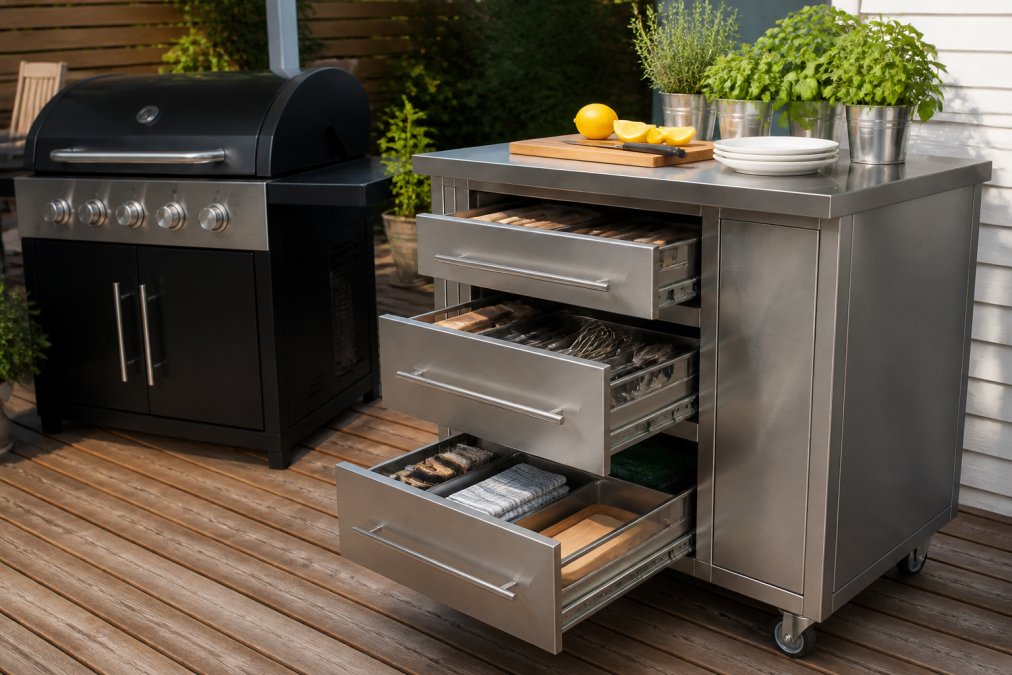
What to Look For in a Rolling Prep Cart
- Locking casters so the cart stays put while you cut
- Weather-resistant materials such as stainless steel or treated metal
- A lip or rail to stop trays from sliding off
- Drawer glides rated for outdoor use
Be cautious with open particleboard shelves on anything that lives outside. Particleboard can swell when it gets wet, and a swollen shelf may sag under a heavy pan.
Fold-Down and Retractable Prep Surfaces for Tight Patios
A fold-down prep station adds counter space only when you need it, which is the whole point on a tight patio. Folded up, it takes almost no room. Folded down, it gives you a landing zone for a cutting board or a tray.
Store-Bought vs. Custom-Built: A Trade-Off, Not a Verdict
Most fold-down surfaces fall into two camps, and neither is automatically better.
- Store-bought fold-down shelves and brackets come with a stated load rating and mounting instructions, so you know what they are designed to carry. The trade-off is fixed sizes that may not match your wall or post.
- Custom-built surfaces can be sized to your exact space. The trade-off is that the builder has to choose hardware rated for the load and the mounting surface, and there is no manufacturer rating for the finished piece.
Match the Surface to the Load
A fold-down surface is only as strong as its weakest part: the hinge, the bracket, or the mounting surface. Before buying or building, ask:
- What is the rated load of the bracket or shelf?
- What is the mounting surface (wood post, masonry, or metal cart side)?
- Will the surface stay loaded for the whole cook, or only briefly?
Mounting Surface Matters
A bracket rated for a wood post may not be appropriate for a hollow metal cart side or a masonry wall. Fastener type and the material you mount into both affect how much weight the surface can safely hold. If you are unsure what your mounting surface can support, consult the bracket manufacturer's guidance or a qualified professional before loading it. A fold-down surface mounted to something that cannot carry the load is a hazard, not a convenience.
Weather and Wear on Moving Parts
Hinges and brackets are the parts most exposed to wear outdoors. Look for stainless steel or powder-coated hardware, and check pivot points for play each season. Follow the manufacturer's lubrication guidance, and avoid mixing dissimilar metals at fasteners, which can speed up corrosion.
Placement: Where Fold-Down Beats Fixed
Fold-down surfaces earn their keep in three spots:
- Beside the grill, for plating and resting hot tools.
- Near the door, for staging ingredients before the carry-out.
- On a cart side, to extend a mobile prep station without widening its footprint.
In each case, the surface is used in short bursts, which is the pattern fold-down surfaces are built for. If you need a surface that stays loaded for the whole cook, a fixed counter or a rolling prep cart is usually the better answer.
Compact Appliances and Multi-Functional Equipment That Earn Their Footprint
Compact equipment earns its place when it does more than one job. In a small outdoor kitchen, every item has to justify the space it takes, so it helps to buy for overlap: one piece that covers two kinds of cooking can replace two pieces that each do one thing.
A freestanding gas griddle is a good example. The flat top can handle breakfasts, smash burgers, vegetables, and side dishes that would otherwise need extra pans. Before choosing any cooking equipment for a tight space, compare its footprint and the manufacturer's clearance requirements with your measured layout, including room to open the lid and stand at the controls.
Weatherproofing and Material Durability for Outdoor Prep Gear
Material choice strongly affects how long your prep gear lasts. Outdoor surfaces face rain, sun, and temperature swings that indoor kitchens never see.
Materials that tend to hold up well:
- 304 stainless steel for drawers, doors, and hardware
- Powder-coated steel for frames and rails
- Teak or sealed hardwood for fold-down surfaces
- Marine-grade hardware for anything near salt air or water
Covers help too. Whatever the material, follow the manufacturer's care instructions for cleaning and seasonal storage.
Small Backyard Kitchen Mistakes to Avoid
The biggest mistake is buying gear before mapping the workflow. A great grill in the wrong spot still leaves you with nowhere to set a tray.
Other common errors:
- Filling every surface with decor. Counters are for work, not display.
- Skipping drawer inserts. Loose tools slide around and waste drawer depth.
- Forgetting about light. You cannot prep what you cannot see. Use lighting rated for outdoor use, and leave any wiring to a qualified electrician.
- Overbuilding the first version. Start with carts and freestanding pieces, then adjust once you know how you cook in the space.
| Problem | Fix | Why It Helps |
|---|---|---|
| Cluttered counter | Wall-mounted rails and hooks | Frees the work surface |
| No landing zone | Fold-down shelf or rolling prep cart | Adds space only when needed |
| Tools scattered | Drawer inserts and dividers | Keeps gear findable |
| Waste piling up | A pull-out trash drawer in an outdoor kitchen island | Hides and contains waste |
| Gear rusting | Stainless steel hardware and covers | Helps extend service life |
If you have an outdoor kitchen island, built-in storage can take the same pressure off your counters. The Wildfire Pull-Out Trash Drawer, for example, installs in an island and keeps waste out of sight. Built from 304 stainless steel with soft-close hardware, its compact width suits smaller outdoor kitchens.

Frequently Asked Questions
How can I create more prep space in a tiny backyard kitchen without permanent construction?
Start with movable pieces rather than anything fixed. A rolling prep cart, a fold-down side shelf, and a wall-mounted rail for utensils can add usable surface and storage without altering your patio. Look for carts and storage built from weather-resistant materials such as stainless steel, and choose pieces sized to your actual footprint. The goal is prep space you can reposition, store, or roll out of the way when the cooking is done.
What is the best way to organize outdoor kitchen cart storage so it actually helps during cooking?
Group items by task, not by type. Keep grilling tools, seasonings, and a cutting board on the cart closest to the grill, and keep platters and serving pieces near where food leaves the cooking zone. Use drawer inserts and dividers so tools do not slide around, and keep heavier items in lower drawers. Drawers that extend fully make it easier to reach the back without pulling everything out, which matters in a cramped space.
What equipment choices help save space in a small backyard kitchen?
Multi-purpose equipment usually beats several single-purpose pieces. A freestanding gas griddle can handle breakfast, searing, and side dishes that would otherwise need extra pans. If you plan to use more than one cooker in the same area, check each manufacturer's manual for clearance requirements before deciding where to place them. Measure your space first, then confirm what fits your patio and your local codes.
How do I plan a functional path from the house to the grill?
Sketch the route you will actually walk: door, prep surface, cooking zone, and serving area. Keep that path clear of storage and furniture, so you aren't sidestepping a cart with a hot tray. Place your main prep surface between the door and the grill so you handle ingredients once, not carry them back and forth. This kind of outdoor kitchen workflow planning reduces trips and makes a small footprint feel far more usable.
A small backyard kitchen only feels cramped when the layout fights the cook. Fix the workflow first, then add storage that moves, folds, or hangs. Backyard Kitchens Direct carries freestanding gas grills and griddles, outdoor kitchen islands, and island components like drawers and doors, so you can build a setup that fits the space you actually have.


