


Small Patio Grill Setup: Practical Ideas for Outdoor Cooking
Table of Contents
- Start with Your Cooking Habits, Not Just the Space
- Measure Your Patio and Map the Workflow
- Choosing Equipment for a Small Patio Grill Setup
- Freestanding Grill vs Built-In: What Changes in a Compact Space
- Outdoor Grill Prep Station Ideas That Save Space
- Plan for Storage and Utility Access
- Your Small Patio Grill Setup Checklist
- Conclusion
- Frequently Asked Questions
Last Updated: September 11, 2026
Start with Your Cooking Habits, Not Just the Space
A successful small patio grill setup starts with how you actually cook, not with the square footage you have to fill. Many homeowners shop for equipment first and discover later that their patio layout, storage, or utility access creates friction every time they fire up the grill.
Before measuring anything, write down what you cook most often: weekday burgers, weekend low-and-slow smoking, or big griddle breakfasts. That answer determines whether a small patio grill setup needs a compact gas grill, a freestanding griddle, or a vertical smoker.
The equipment type matters more than brand. A small patio grill setup built around a freestanding gas grill like the Summerset Quest 30-Inch Freestanding Gas Grill handles direct and indirect heat well. A freestanding gas griddle suits high-volume breakfasts and stir-fries. A smoker serves dedicated barbecue fans.

Measure Your Patio and Map the Workflow
Before you shop for equipment, you need a precise picture of your available space. A tape measure and a simple sketch are the most important planning tools for a small patio grill setup.
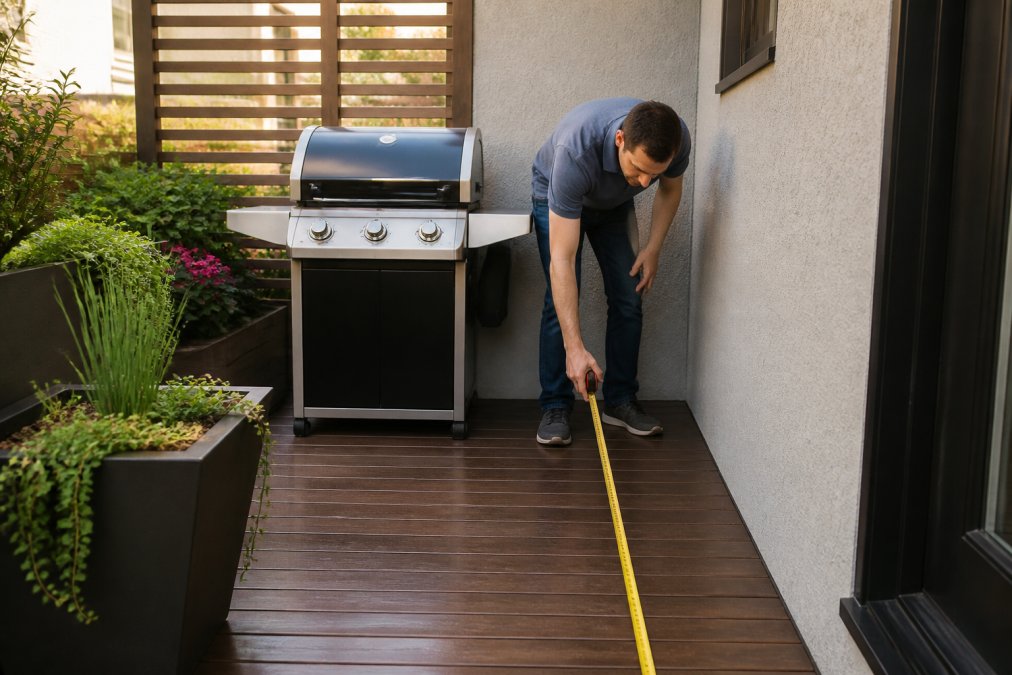
Step 1: Document the Hard Dimensions
Measure the full length and width of the patio, recording the numbers in inches. Next, note the location and dimensions of permanent features you can't move: exterior walls, door swings, railings, steps, and structural posts. Also, mark the position of any outdoor electrical outlets and gas line stub-ups.
Step 2: Create a Zone Map, Not Just a Furniture Layout
Instead of just drawing where the grill will sit, map out distinct functional zones. The three primary zones are:
- The Prep Zone: A surface for staging raw ingredients, holding platters, and setting down tools. Keep this close to the indoor kitchen door to minimize the distance you carry items.
- The Cooking Zone: The area occupied by the grill, griddle, or smoker, plus the clear space needed to operate it safely. This is a high-traffic, high-heat area.
- The Serving Zone: A spot for setting down cooked food, holding plates, and serving guests. Keep this separate from the prep zone to avoid cross-contamination and traffic jams.
On your sketch, draw these as overlapping circles or blocks. The goal is a logical flow, Prep to Cook to Serve, without the zones forcing you to walk through the primary traffic lane.
Step 3: Apply the 'Work Triangle' Concept
Kitchen designers often use a work triangle between the sink, stove, and refrigerator. For a compact outdoor setup, a simplified version applies to the path between your indoor kitchen door, the grill, and the serving area. If that path isn't a straight line, or forces you to walk behind a hot cooking surface, you'll need to adjust the layout. The most efficient small patio grill setups place the grill along a wall or in a corner, creating a natural L-shaped or straight-line workflow.
Step 4: Visualize the 'Open-Lid' Footprint
A frequent planning error is measuring only the grill's cart footprint. When the lid is open, it extends backward and upward. Mark this 'open-lid zone' on your sketch so the lid can open fully without hitting a wall, window, or railing.
Once you have a zone map and a clear workflow, you can make an informed decision about equipment size and configuration.
Choosing Equipment for a Small Patio Grill Setup
The best equipment for a compact patio balances cooking capacity against the footprint it leaves behind. Freestanding gas grills in the 30-inch range offer generous cooking surface area without dominating a small space. A 30-inch freestanding gas grill, such as the Summerset Quest 30-Inch shown above, delivers substantial cooking power in a cart configuration that fits against a wall or in a corner.
Freestanding griddles deserve serious consideration for small patios. Their flat cooking surface handles eggs, pancakes, vegetables, and smashed burgers with equal ease, and many models include folding shelves that tuck away when not in use. For smoke flavor without a dedicated smoker's footprint, a vertical propane smoker takes up minimal floor space while providing multiple cooking racks.
Electric grills and smokers solve the fuel question for balconies and patios where gas is not an option. Many compact electric smokers, like the Dyna-Glo 2-Door 40 In. Digital Electric Smoker, offer digital temperature control and built-in meat thermometers. Check your local regulations and the product manual before choosing a fuel type.

| Equipment Type | Best For | Footprint | Prep Needs |
|---|---|---|---|
| Freestanding gas grill | Direct and indirect grilling | Moderate | Side shelves or nearby table |
| Freestanding griddle | Breakfast, stir-fry, flat-top cooking | Low to moderate | Minimal, often built-in |
| Vertical smoker | Low-and-slow barbecue | Low, tall profile | Small side table |
| Electric smoker | Balconies, no-gas situations | Low | Minimal |
Freestanding Grill vs Built-In: What Changes in a Compact Space
Freestanding grills and built-in enclosures serve different patio realities, and the distinction matters most in tight spaces. A freestanding grill sits on its own cart with wheels, so it moves freely and requires no permanent construction. Built-in grills drop into a fixed enclosure, which demands dedicated space and professional installation.
For most small patios, a freestanding grill is the practical choice. The cart adds storage underneath, the wheels make seasonal storage simple, and the unit can be repositioned when entertaining. Freestanding grills generally require less complex planning for permitting and ventilation than permanent built-in installations.
Built-in grills and modular outdoor kitchen islands make sense when the patio has room for a permanent cooking station. A modular outdoor kitchen island combines a grill with countertop space, storage, and optional features such as sinks or refrigerators in a factory-built unit. These islands do not require a contractor, but they do need a level, stable base and a clear plan for utility hookups where applicable.
Contractor-built outdoor kitchens require professional design, construction, and often permits for gas, electrical, and plumbing work. For a small patio grill setup, a freestanding grill plus a rolling prep cart can be a practical solution.
Outdoor Grill Prep Station Ideas That Save Space
Prep space is the scarcest resource on a small patio. A common approach is to dedicate one wall or corner to a compact prep station using wall-mounted folding tables that drop down when needed and store flat against the wall.
Freestanding grill carts with foldable side shelves provide a built-in prep area that travels with the grill. Many 30-inch gas grills include side shelves that flip up for food staging and fold down for compact storage. For griddles, a magnetic spice rack or tool rail keeps seasonings and spatulas within reach without taking up cooking surface.
Vertical storage moves supplies off the counter entirely. Wall-mounted hooks hold grill tools, a magnetic strip secures spatulas and tongs, and a small shelf unit stores cutting boards, rubs, and serving platters. A dedicated tray or caddy for carrying raw ingredients from the indoor kitchen to the grill eliminates the need for a permanent outdoor prep surface.
A rolling utility cart with a butcher-block top offers flexible prep space and can be parked under an overhang when not in use. These carts add storage for grilling accessories and can double as a serving station. Choose a cart with rust-resistant materials suited to outdoor exposure.
Plan for Storage and Utility Access
A small patio grill setup lives or dies by its storage and utility planning. Without a designated place for tools, fuel, and accessories, the space quickly becomes cluttered.
Vertical Storage: The Key to a Small Footprint
When floor space is limited, the only direction to build is up. A well-planned vertical storage strategy keeps items within arm's reach of the grill.
- Wall-Mounted Tool Racks: A simple rail or board with hooks can hold spatulas, tongs, brushes, and grill gloves. This keeps frequently used tools accessible without taking up counter or cart space.
- Magnetic Strips: A magnetic knife strip mounted on a wall or the side of a grill cart is an excellent way to store metal tools. This space-efficient method also keeps tools visible and organized.
- Shelving Units: A narrow, freestanding shelving unit can store cutting boards, rubs, sauce bottles, and serving platters. Look for units made of rust-resistant materials like stainless steel or powder-coated aluminum to withstand outdoor conditions.
- Over-the-Door Organizers: If your patio has a door leading to the house, an over-the-door organizer with pockets can hold small items like lighter fluid, foil, and spice jars, keeping them off the main prep surfaces.
Managing Propane Tanks and Fuel
For propane grills, the tank is necessary but bulky. The most common solution is a freestanding cart with an enclosed tank storage area in the base. When positioning the grill, ensure the tank storage area is accessible for easy connection and replacement. Always consult your grill's manual for specific instructions.
If you are considering a natural gas grill, your home's gas line location is a primary constraint. Position the grill close enough to the existing line for a qualified professional to make a safe connection. Your patio layout sketch, with utility locations marked, is essential for this planning.
Power for Electric and Smart Grills
Electric grills and smokers require a dedicated outdoor-rated electrical outlet. Before choosing an electric model, verify that your patio has a suitable outlet within the cord's reach. If not, consider consulting a licensed electrician to install one.
Protecting Equipment from the Elements
Outdoor equipment faces sun, rain, and temperature swings. A high-quality grill cover is the first line of defense. Choose a cover specifically sized for your grill model. For carts and islands, stainless steel is a popular choice for its durability, but it still requires occasional cleaning. Always check the manufacturer's care instructions.
Your Small Patio Grill Setup Checklist
Use this checklist to confirm the small patio grill setup covers the essentials before purchasing equipment or finalizing the layout.
- Measured the full patio dimensions and noted permanent features
- Mapped the workflow: kitchen door to prep surface to grill to serving area
- Confirmed a clear walking route that avoids the hot cooking zone
- Matched equipment type to actual cooking habits, not aspirational ones
- Verified fuel source availability: propane tank storage or natural gas line proximity
- Considered local regulations and HOA rules for balcony or patio grilling
- Considered the product manual for clearance and placement requirements
- Identified prep surface solutions: foldable shelves, wall tables, or rolling cart
- Planned vertical storage for tools, spices, and grilling accessories
- Selected a weatherproof cover sized to the specific grill model
- Confirmed the grill position allows full lid opening and safe movement
Conclusion
A small patio grill setup succeeds when the equipment matches the cooking habits, the workflow stays clear, and the storage plan keeps the space usable. Start with honest measurements, choose freestanding equipment for flexibility, and add prep surfaces that fold away or roll out of sight.
Frequently Asked Questions
What is the best small outdoor grill for a limited patio?
The best small patio grill setup depends on how you cook. A 30-inch freestanding gas grill, like the Summerset Quest or a Bull Angus 30-inch grill head on its matching pedestal cart, offers a substantial cooking area without the footprint of a full outdoor kitchen island. If you prefer pancakes or smash burgers, a freestanding gas griddle might suit you better. For low-and-slow cooking, a compact vertical smoker works well. Match the equipment to your primary cooking style and the space you have available.
What is the difference between freestanding and built-in grill setups?
A freestanding grill sits on its own cart or legs and can be moved, making it a flexible choice for a small patio grill setup. A built-in grill is designed to be installed in a non-combustible enclosure, often a permanent structure. Freestanding models often require less complex installation planning. Built-in setups offer a seamless look but demand more forethought for ventilation, clearances, and construction. Always consult the product manual and a local professional for installation specifics.
How can I maximize prep space in a small patio grill area?
Look for freestanding grills with foldable side shelves that add prep space when needed and tuck away for storage. A portable cart or compact outdoor kitchen island can add countertop space and storage for accessories. Think vertically: wall-mounted racks, magnetic tool holders, and hooks can keep utensils within reach without taking up valuable floor space. Position your prep surface close to the grill to create an efficient workflow between the two zones.
Where should a grill be placed on a patio?
Placement depends on your specific patio layout, local building codes, and the manufacturer's clearance requirements in your grill's manual. Consider the path you will use to carry food and supplies from the kitchen. Position the grill so it doesn't block main walkways. Also consider wind direction and how smoke might drift toward doors or windows. For any questions about clearances or placement rules, consult the product manual and local qualified professionals.
The right equipment turns a compact patio into a functional outdoor cooking space. Backyard Kitchens Direct carries freestanding gas grills, freestanding gas griddles, smokers, and modular outdoor kitchen islands built with enduring materials and clean design.


